Dans un commentaire publique à propos de la guerre israélo-étasunienne,
le ministre de la défense des États Unis, Pete Hegseth a évoqué la
construction du 3ème temple de Jérusalem, ce qui signifie :
Que le messianisme religieux sioniste a infiltré le pouvoir exécutif
étasunien car cette reconstruction signifierait la destruction préalable
de la mosquée Al Aqsa, qui est le 3ème lieu saint pour 2 milliards de
musulmans.
Que les évangélistes étasuniens sont liés et subordonnés aux objectifs
sionistes, en convergence dogmatique avec une subordination déjà
effective des USA au lobby financier sioniste.
By Kit Klarenberg and Wyatt Reed – The Grayzone Oct 05, 2025
A roving reporter who covered
Italy’s top politicians explains to The Grayzone how his country was
reduced to a joint US-Israeli “aircraft carrier,” and raises troubling
questions about an Israeli role in the killing of Prime Minister Aldo
Moro.
For years, Israel’s Mossad monitored and secretly influenced a
violent communist faction that carried out the March 16, 1978 kidnapping
and murder of Italian statesman Aldo Moro, veteran investigative
journalist Eric Salerno has documented.
Having worked closely alongside multiple Italian heads of state
during his 30-year career as a correspondent, Salerno published an
expose of their secret relationship with Israeli intelligence in 2010
called Mossad Base Italy.
The reporter told The Grayzone that Moro, who was arguably Italy’s
most important leader, became a thorn in the side of powerful forces who
sought to keep his country firmly lodged in the pro-Western bloc.
Salerno believes Italy’s long-term foreign policy would have developed
differently if Moro had survived, adding, “that’s what they were afraid
of in the United States.”
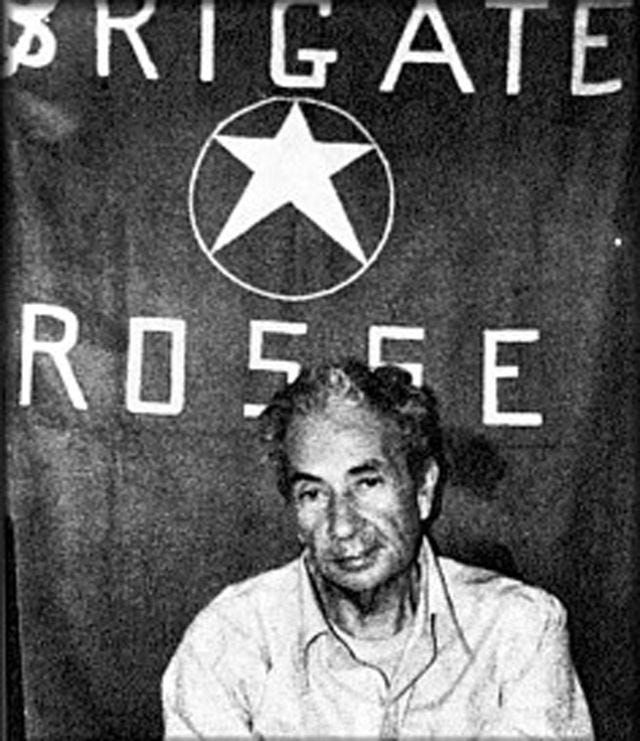
Moro was kidnapped in 1978 by the radical Brigate Rosse, or Red
Brigades faction, in a daring and highly-professional daytime operation
which left all but one of his bodyguards dead. He was executed two
months later. The still-unresolved case shocked the nation, and remains a
deeply unsettling chapter in the period of intelligence intrigues and
political terrorism known by Italians as The Years of Lead.
For some of Italy’s most knowledgeable sources, the crimes bore
strong similarities to those of Operation Gladio, a covert effort which
saw the CIA, MI6 and NATO train and direct a shadow army of fascist
paramilitary units across Europe that carried out false flag terror attacks, robberies, and assassinations aimed at neutralizing the socialist left.
Moro, who belonged to the progressive wing of the Christian Democrat
Party and served five terms as prime minister, threatened to upend the
traditional postwar order in Italy by forging a “compromesso storico”
(historic compromise) with the Italian Communist Party. “It was
something that probably part of the Italian political establishment was
afraid of, even in his own party,” Salerno notes.
While this part of Moro’s history is well known among Italians,
Salerno has documented a less understood aspect of his legacy: his
arrangement with Palestinian resistance groups, likely mediated by
Libyan President Moammar Gaddafi, which allowed the PLO and others to
smuggle weapons and travel freely through Italy in exchange for the
country itself being spared from terror attacks. That deal, which scholars consider to be an evolving and “dynamic process,” came to be known as the “Lodo Moro.”
The pact is widely believed to have been forged in 1973, during
Moro’s tenure as foreign minister, when Italy secretly released a group
of Palestinian fighters who sought to attack a plane belonging to
Israel’s El Al airline as it departed from Rome’s Fiumicino airport. It
was spurred in large part by Italy’s desire to maintain a level of
independence from the US-led Western bloc, which was targeted by an oil
embargo in retaliation for Washington’s support for Israel in the 1973
Arab-Israeli War.
While Salerno stopped short of alleging the Mossad directly ordered
the abduction and execution of Moro, he told The Grayzone, “I think
their idea was, ‘we’ll see what happens, and if it’s necessary, and we
think it’s the right time, we can help one way or another.’”
For over a decade, the Lodo Moro deal insulated Italy from the
violence that plagued other nations across the Mediterranean. These
plots became increasingly commonplace in the region following the 1967
Six-Day War between Israel and a coalition of Arab states including
Egypt, Syria, and Jordan.
But it was only a matter of time before the violence consumed Moro’s life as well.
Italian Prime Minister Aldo Moro in Red Brigade captivity, 1978
Mossad Base Italy
Salerno’s book, Mossad Base Italy, is
perhaps the most comprehensive chronicle of the intimate and ongoing
relationship between Israeli intelligence and Italy’s political
leadership. Published in 2010, the book remains almost completely
unknown in the English speaking world.
Its author illustrates how the secret Israeli-Italian alliance predated the May 1948 creation of Israel, with Rome providing covert support to
Zionist militias like the Haganah. Individuals affiliated with Benito
Mussolini and neofascists within Italy’s post-war security apparatus
supplied them with weapons and training to crush Palestinian resistance
and assist their campaign of ethnic cleansing.
“The Israelis didn’t want Rome to become a
satellite of the Soviet Union, and the US had the same position. The
country was essentially the West’s front line against the Eastern bloc,”
Salerno explained to The Grayzone. “Italy bordered Yugoslavia, was not
far from Warsaw Pact nations, and support for Communism and the Soviet
Union was strong in the wake of World War II. It was also a kind of
aircraft carrier in the Mediterranean, which people would land on and go
off to other places.” With nearly 5,000 miles of coastline, and just 90
miles separating the island of Sicily and Tunisia, Italy has often been described as the “gatekeeper” of the Mediterranean Sea.
Salerno concluded that every Italian
administration since World War II has secretly aided Mossad and Israeli
military intelligence. A review of his book by veteran Haaretz
intelligence correspondent Yossi Melman noted,
“Israeli espionage agents confirm that Italy’s intelligence services
are among the friendliest in the world toward their Israeli
counterparts.”
Salerno argues persuasively that both the
Mossad and Israeli Air Force were effectively “born in Rome,” and
reveals Tel Aviv entrusted Italian intel with conducting “extremely
classified missions” on their behalf. Strikingly, his book has never
been translated into English.
The reporter attributes the consistent
pro-Israel bias of Italian intelligence to a combination of political
expediency and lingering collective guilt over Rome’s complicity in the
crimes against Jews during World War Two. Since then, Italy’s
governments have largely “felt… that they had to help the Jews because
the Jews had been suffering under the previous regime.”
“Objective evidence” Mossad downed Italian airliner
The traditional dynamic between Rome and
Tel Aviv was challenged by the emergence of Italian Christian Democrat
Party governments, including Moro’s. Within months, Israel began
responding to this defiance with apparent acts of sabotage inside Italy,
according to a variety of well-placed figures.
In late 1973, five members of the Black September Palestinian militant group were arrested thanks
to a tipoff from the Mossad, which claimed they were preparing to shoot
down an Israeli commercial airliner at Rome’s largest airport with
ground-to-air missiles. However, Moro arranged for them to be released a
month later, then transported to Libya.
The Black September members were first
flown to Malta on an Italian transport plane known as Argo 16 — which
was routinely used to ferry Operation Gladio operatives to a secret
training base in Sardinia, and deliver CIA/MI6 weapons to secret depots
dotted around the country. When Mossad observed the
Palestinians there and realized they’d been freed, they became “very
annoyed,” according to Rome’s then counterespionage chief, Ambrogio
Viviani.
On November 23 1973, Argo 16 crashed shortly after taking off from Venice Airport, killing the entire veteran crew.
An initial probe concluded the tragedy was
an accident, but the case was reopened by the Venice prosecutor’s
office in 1986. That investigation faltered as well, when security and
intelligence officials refused to testify, and began withholding
evidence. However, the judge overseeing the case, Carlo Mastelloni, told
Salerno there was no doubt, based on “objective evidence,” that the
plane’s downing was Israel’s dirty work.
“It’s all tied to the famous ‘Moro
agreement,’” Mastelloni asserted. Argo 16’s sabotage was not only
“retaliation” for the release of the arrested Palestinians, but a
“warning” over Italy’s “concessions” to “Tel Aviv’s enemies,” he stated.
Still, Lodo Moro continued to hold despite the implicit threat of
violence, which raises the question of whether Mossad felt the need to
up the ante.
‘Mossad decided to transfer the Middle Eastern conflict to Italy’
Argo 16 was not the only fatal incident to
take place during Italy’s Years of Lead which seemed to bear the
Mossad’s fingerprints. When a hand grenade was lobbed at Milan’s police
headquarters in May 1973, killing four civilians and injuring 45, the
culprit presented himself as an anarchist following his immediate apprehension. However, subsequent investigations revealed
the perpetrator, Gianfranco Bertoli, to be a longtime Italian military
intelligence informant, as well as a member of numerous neofascist
organizations, including the Gladio-linked Ordine Nuovo (New Order).
Bertoli had spent the two years leading up to the attack residing off and on in Kibbutz Karmiya in Israel, where he frequently hosted representatives
of French far-right faction Jeune Révolution, while maintaining contact
with French intelligence. Such incidents prompt Salerno to ask: “was
the Mossad part of the strategy of tension?” This was the precise conclusion reached by Ferdinando Imposimato, an Italian magistrate who oversaw initial trials of Red Brigades operatives regarding Moro’s murder.
“It must be acknowledged the Israeli
secret services had perfect knowledge of the Italian subversive
phenomenon from its very beginning, engaging in it with constant
ideological and material support,” Imposimato noted in 1983. “Mossad had
decided to transfer the Middle Eastern conflict to Italy,” he
concluded, “driven by the aim of political and social destabilization.”
Israel’s purpose was “to induce America to see Israel as the only allied
point of reference in the Mediterranean and thus gain greater political
and military support,” he stated.
During his March 1999 testimony
to a parliamentary inquiry into terrorism in Italy, Red Brigades
fighter Alberto Franceschini stated the group was approached by the
Mossad through an intermediary after the Red Brigades’ kidnapping of a
magistrate named Mario Sossi in April 1974. According to Franceschini,
the Mossad made a “disturbing” proposition to finance his group, stating
that rather than seeking to control the Red Brigades, Israel sought
only to ensure the group continued to operate:
“We don’t want to tell you what you have
to do. That is, what you do is fine with us. We care that you exist. The
very fact that you exist, whatever you do is fine with us.”
Describing “the political motivations” for
Mossad’s position, Franceschini noted: “from the perspective of
American relations… the more destabilized Italy was, the more unreliable
it became, and the more Israel became a reliable country for all
Mediterranean policies” from Washington’s perspective. In his final
years, Franceschini revealed Israel “offered weapons and assistance” to the Red Brigade, declaring: “their stated goal was to destabilize Italy.”
As Salerno noted to The Grayzone, “in one of his last interviews,” Franceschini “confirmed to my colleague from Corriere della Serra that
the Mossad had been in contact from the very beginning with the Red
Brigades,” interactions which the correspondent stresses were “very
normal in the way the Mossad acted with all kinds of, let’s call them
subversive organizations, all over Europe.”
The notion of a potential Israeli hand in
shaping the Moro plot — or hindering efforts to resolve it peacefully —
is bolstered by statements from a number of influential Italian
politicians, which also indicate Israel both “co-financed” and
“influenced” the group which took credit for killing Moro. These
disclosures have so far been universally ignored by mainstream
English-language outlets.
In July 1998, Giuseppe De Gori, a lawyer who represented Moro’s Christian Democrat party in numerous trials related to the case, told a parliamentary commission on
terrorism that Mossad “had always controlled” the Red Brigades, without
formally infiltrating the group. He recorded how in 1973, a Mossad
major and colonel “presented themselves” to the group, exposing
infiltrators in their ranks, and offering “weapons and whatever they
wanted as long as they pursued a different policy.”
While the Red Brigades refused, “from that
moment on, it was clear Mossad” kept a close eye on the militant
faction. De Gori testified that Israeli intel “hated” the “anti-Zionist”
Moro, and began taking advantage of its ability to “smuggle”
information to the Red Brigades, which could influence their actions.
As
the lawyer explained, there was “no need” for the Mossad to directly
penetrate the Red Brigades. De Gori hinted the group’s decision to kill
Moro after almost two months in captivity resulted from such indirect
Israeli intervention. While Italian government officials refused any
negotiation with his kidnappers, at a private meeting on May 8, 1978,
elements within the Christian Democrats proposed independently brokering
a deal to secure Moro’s release.
“Moro was killed immediately afterward, so someone must have been there who reported this news,” De Gori testified. In 2002, the lawyer told author Philip Willan that Mossad made Moro’s execution a fait accompli by enlisting the services of a skilled forger to fabricate a letter from the Red Brigades to authorities in mid-April 1978. The communique claimed the statesman was already dead. “After that… Moro could no longer be saved,” De Gori stated.
Bargain with Palestinian resistance puts target on Moro’s back
De Gori is not the only well-placed source
to blame Mossad for Moro’s death. In May 2007, Giovanni Galloni, former
vice president of the Italian judiciary’s High Council, boldly proclaimed that
“not all participants” in the premier’s abduction had been members of
the Red Brigades. That conclusion was spurred by Moro’s bodyguards being
executed with “just two weapons, used by exceptionally experienced
men.” In addition to never being identified, these assassins displayed a
level of shooting expertise no known Red Brigades operative seemed to
possess.
Galloni strongly insinuated the killers
were hired by Washington and/or Tel Aviv. He revealed that “a few months
before his capture,” Moro confided to him that he was “worried” the US
and Israeli “secret services had infiltrated the Red Brigades.” Moro
reported this to Italy’s US ambassador, prompting an “ambiguous denial”
from the State Department, to the effect Washington had always told
Italian intelligence “everything we know.”
Galloni enquired: “Which secret services?
The real ones, or the ones that were in their hands?” He was clearly
referring to the parallel Anglo-American spying and terror nexus in Rome
known as Operation Gladio.
Further evidence of an Israeli role in Moro’s murder can be found in testimony delivered to an Italian parliamentary committee in June 2017 by
a former magistrate named Luigi Carli, who was intimately involved in
the original investigation. Unnoticed in the English-speaking world, and
unmentioned in the committee’s official reports, Carli claimed the Red
Brigades had been “co-financed” by Mossad.
When asked why Israel would subsidize an
armed communist faction in Italy, Carli stated that “several” former Red
Brigades collaborators had told him the Mossad had agreed to “take care
of co-financing the Red Brigades,” proposals which he considered
“strange.”
They explained, however, that any efforts
which ended up “weakening, or helping to weaken, Italy’s internal
situation” would “enhance Israel’s prestige and authority” in the
Mediterranean, Carli testified.
Highly illuminating interviews with
former Italian president Francesco Cossiga, published by the Bulletin
of Italian Politics in the wake of his death in August 2010, shed
further light on Mossad’s motives for assassinating Moro, and for
targeting Rome with mass casualty false flag bombings. Cossiga was the
first Italian politician to acknowledge the existence of the Lodo Moro.
Cossiga stated the US was “of course” aware of the agreement, while he
himself and much of Italy’s political class were in the dark.
Cossiga recalled that while he was Prime
Minister in November 1979, police in a coastal town intercepted a truck
carrying a surface-to-air missile. He subsequently received a telegram
from Popular Front for the Liberation of Palestine chief George Habbash
admitting ownership of the missile, and reassuring the Italian premier
it was not intended for use in Italy. Habbash thus demanded the weapon
be returned and called for the driver’s release.
Habbash warned that any failure to comply
would represent a violation of the PFLP’s “agreement” with Rome. “No one
could tell me what this part meant,” Cossiga insisted. Only “many years
later” did he learn of the Lodo Moro agreement.
At the time of Cossiga’s interviews, the Italian state reopened investigations
into the August 1980 bombing of Bologna Centrale railway station, which
killed 85 people and wounded over 200. The probe resulted in
convictions in absentia for members of the neofascist, Gladio-tied
Nuclei Armati Rivoluzionari. Several chief suspects, including a confirmed MI6 asset named Robert Fiore, escaped to London, where Britain refused to extradite them. The Bulletin of Italian Politics identified the missile seizure, and the existence of Lodo Moro itself, as key considerations in the new investigation.
One possibility explored by the inquiry
was whether the Bologna bombing was “carried out by the US or Israel to
punish Italy for its pro-Arab stance.” Having long complained that Rome
“never really had space for its own foreign policy” due to its
subservience to US interests, Cossiga acknowledged that Italy “pursued a
national agenda” in the Middle East and “took certain liberties towards
the Arab world and Israel.”
“People forget” the Christian Democrats
were “always a pro-Arab party,” Cossiga stated, pointing specifically to
Moro and his associate Giulio Andreotti, another former Italian head of
state who famously exposed Operation Gladio in October 1990.
Cossiga claimed, “Andreotti has always believed — though he’s never
said it,” that the US caused him “judicial problems” over his Arab
sympathies.
Though Salerno disputes the
characterization of Andreotti as “pro-Arab,” describing him instead as
“pro the rights of Arabs,” he told The Grayzone that the longtime
Italian leader once personally declared to him: “if I was born in Gaza, I
would be a terrorist.”
Moro rescue committee set up to fail
Throughout Moro’s 55 days in Red Brigades
captivity, Italian officials declared that the “state must not bend” to
“terrorist demands,” making it clear the Italian government would
neither negotiate with the Red Brigades nor release any of its jailed
members in return for the PM. The former Italian Prime Minister was
subsequently bundled into a car trunk, shot 10 times, and left in the vehicle in central Rome for authorities to find.
Today,
many Italians view Rome’s inflexible approach with deep suspicion,
given the government’s willingness to negotiate with terrorists both
before and after Moro’s murder. Magistrate Mario Sossi, whose kidnap by
the Red Brigades purportedly prompted Mossad to approach the group,
When the Red Brigades kidnapped Christian Democrat politician Ciro Cirillo in April 1981,
Italian authorities bargained directly with his abductors, paying a
ransom for his release. That December, when the Red Brigades abducted US
General James Dozier, he was “located and freed in a blitz” by a joint US-Italian taskforce.
Former Italian general Roberto Jucci
contrasted Dozier’s treatment with that of Moro in a 2024 interview.
“One of them, they wanted to set free; I have my doubts about the
other,” he stated.
Jucci was among the few Italians in a position to judge, having been
placed in charge of training a special forces squad at a base in
Tuscany, which was ostensibly meant to rescue the abducted Prime
Minister. Today, he believes “the real goal was to get me out of the
way” and ensure Moro was never found. No raids were conducted during his
55 days in captivity.
Jucci told La Repubblica that the formal
committee to rescue Moro was “advised by a man sent by the US,” and
“composed largely” of representatives of fascist, Gladio-affiliated Masonic
lodge P2. These individuals “wanted things to go in a different way
from what all honest people were asking for,” and wished for Moro “to be
destroyed politically and physically.”
Had Moro survived, “Italy’s politics would
have developed differently.” Jucci believed the Italian leader could’ve
“been freed if all the institutions had worked in this direction.” Declassified British
Ministry of Defence files dating to November 1990 show officials in
London were well-aware of the role played by P2 in sabotaging official
efforts to rescue Moro. The Masonic lodge was described as just one
“subversive” force in Rome, employing “terrorism and street violence to
provoke a repressive backlash against Italy’s democratic institutions.”
Those documents further noted
“circumstantial evidence” indicated “one or more of Moro’s kidnappers
was secretly in touch” with Italy’s “security apparatus,” and
investigators “deliberately neglected to follow up leads which might
have led to the kidnappers and saved Moro’s life.”
Mossad continues Italian ops amid Gaza genocide
Today, there is little trace of any
pro-Arab tendencies in mainstream Italian politics. According to
Salerno, the US and Israel no longer have any need to “destabilize
Italy” as the country is economically “weak.” Rome’s government now is
for all intents and purposes “a continuation, even an extension, of the
old fascist regime,” he says, adding, “there are people in the
government that have statues of Mussolini in their houses.”
Prime Minister Giorgia Meloni has made clear she harbors little sympathy for the Palestinians, and little intention of recognizing a Palestinian state – even after it was revealed in November 2024 the
Mossad had been employing a private Italian intelligence firm to target
Meloni and her ministers. “I think that basically, the government that
we have here in Italy at the moment is a government that would like to
criticize many things that are happening,” but “it can’t criticize
Israel too much because of what the Italian fascist regime did to the
Jews during the war,” Salerno explains.
Regarding recent mass protests and
strikes across Italy in support of Gaza, Salerno explains, “What is
happening today in Palestine in Gaza is something exceptional.” But “as
nothing has been taught or spoken about in Italy about the plight of
Palestinians for many years… the great population of Italy and the
governments of Italy” have “never done very much to really help the
Palestinians.” Now, once again, “all of a sudden, we have discovered we
have the Middle East and the Palestinian question.”
To this day, Mossad continues to carry out operations in Italy. The
Italian-Israeli intelligence relationship was most recently highlighted
in a bizarre incident in May 2023, in which a houseboat capsized in
Italy’s Lake Maggiore, killing four people among the 23 aboard. Though
legacy media initially framed the case as a tragic accident at a birthday celebration, it quickly became clear everyone on the boat — bar the captain and his wife — were Israeli and Italian spies.
The 10 surviving Israelis were hurriedly flown back
to Tel Aviv on a military aircraft before they could be questioned by
police, with the apparent blessing of Italian authorities. Subsequent investigations suggested
the gathering was a joint intelligence operation into “Iranian
non-conventional weapons capabilities,” aimed at either surveilling local industry or wealthy Russians living nearby who were suspected of helping Moscow obtain drones from Tehran.
A eulogy for
the dead Israeli spy, whom Italian media named as Erez Shimoni, was
personally delivered by Mossad director David Barnea, strongly
suggesting he was a significant figure at the intelligence agency. While
the captain of the ship has since been convicted of negligent homicide,
Italy’s military police immediately announced they would not be investigating the activities of the spies on board.
Le débat sur la pertinence du paradigme colonial pour la compréhension
de l’histoire du sionisme et, par conséquent, de l’État d’Israël est
ancien. Si la question a été soulevée depuis longtemps par les
Palestinien·nes, elle était déjà discutée dès les origines du mouvement sioniste comme en témoigne une série de lettres de 1907.
Degania, février 1948. Des paysans construisant une barrière et des hommes en armes dans un champ.
Boris Carmi / wikimédia
Un texte qui est souvent cité dans le débat sur la pertinence du
prisme colonial pour comprendre le sionisme est l’article programmatique
« Mur de fer » de Zeev Jabotinsky
dont la parution, en 1923, marque la fondation du courant dit
révisionniste. La thèse principale est que le sionisme doit assumer des
pratiques violentes à l’égard de la population arabe de Palestine.
Jabotinsky tire la nécessité de la violence du fait qu’il s’agit d’un
projet colonial cherchant à établir une souveraineté juive en Palestine
au détriment de la population autochtone. Celle-ci, poursuit-il, ne peut
que s’opposer largement à ce projet, à l’instar de toute population
autochtone. Ce texte s’inscrit en faux contre les organes officiels du
mouvement, qui cherchaient à nier ou à masquer cette dimension coloniale
et violente.
Ce n’était pas la première fois que la question était discutée au
sein du mouvement. Seize ans plus tôt, en 1907, une lettre est publiée
dans l’hebdomadaire hébreu Ha-Olam (« Le Monde »), le journal officiel de l’Organisation sioniste mondiale (OSM),
qui montre que le potentiel violent du sionisme était déjà débattu à
l’époque. C’est trois ans après la mort de Teodor Herzl en 1904, dix ans
après le premier Congrès sioniste à Bâle, et presque trente ans après
le début de l’immigration sioniste en Palestine (la « première alya »,
de 1881 à 1903) et la fondation des premières colonies agricoles juives
de Petah Tikva et Guey Oni. C’est la période qui suit le rejet du
« plan Ouganda » par le mouvement sioniste et la réaffirmation du focus
sur la Palestine.
La deuxième génération de colons
C’est aussi la deuxième génération du mouvement sioniste, façonnée
par les pogroms de l’Empire russe, ainsi que par les réactions
internationales et les manifestations de soutien aux juif·ives.
Leur sionisme se construit en dialogue avec d’autres courants
politiques, notamment socialistes et révolutionnaires, qui attirent les
jeunes juif·ives. Cette nouvelle
génération assume la rupture avec la religion, dont le discours et les
pratiques sont désormais considérés comme obsolètes, notamment parce
qu’ils prolongent l’état d’exil, tandis que les sionistes cherchent plus
ouvertement à établir la souveraineté nationale. Ce sionisme de la
« deuxième alya » (1903-1914) présente une composante plus militante que la « première alya » et plus ouverte à la violence, comme l’indique, entre autres, la fondation de l’organisation Ha-Shomer, « le gardien » en hébreu.
Le projet colonial évolue et se précise. En 1908 est fondée à Londres la société Palestine Land Development Company (PLDC), dont le nom hébreu Hakhsharat Ha-Yishouv
signifie littéralement « la préparation du peuplement ». Elle est
dirigée par Arthur Ruppin, un sociologue formé en Allemagne, qui
introduit les principes de l’organisation moderne du travail et de la
méthode statistique. Comme l’a montré le chercheur israélien Etan Bloom,
Ruppin inscrit le souci démographique, c’est-à-dire le besoin du
mouvement sioniste d’établir une majorité juive en Palestine, dans un
dispositif raciste, inspiré de l’eugénisme allemand de l’époque1. Cela se reflète non seulement vis-à-vis des Arabes palestinien·nes, mais aussi à l’égard des juif·ives immigré·es du Yémen dans les années 1920 que l’on fait venir pour servir de main-d’œuvre bon marché.
L’objectif déclaré de la société dirigée par Rupin est d’aider les nouvelles et nouveaux immigrant·es juif·ives, provenant notamment d’Europe orientale, à s’établir comme paysan·nes
en Palestine. La société achète des terres et y établit des fermes. Par
ailleurs, à cette même époque, on envisage d’autres formes de
peuplement que la colonisation rurale, avec la planification d’Ahuzat
Bayit, officiellement fondé en 1909 et devenu le premier quartier de
Tel-Aviv.
C’est aussi l’époque des idéaux sionistes de la « garde hébraïque »
et du « travail hébreu ». On parle de conquête du travail : les jeunes
juif·ives arrivant d’Europe orientale entrent en compétition avec les travailleur·ses palestinien·nes employé·es
dans les colonies agricoles. C’est également la période où l’hébreu
moderne est conceptualisé et mis au service du mouvement national,
devenant ainsi sa langue officielle. La renaissance linguistique, visant
à moderniser la langue de la Bible et de la littérature rabbinique
selon les critères philologiques et grammaticaux européens de l’époque,
s’inscrit dans le cadre de la renaissance nationale.
À un ami marxiste
L’année 1907 correspond aussi à la première parution du journal Ha-Olam. Le rédacteur en chef est Nahum Sokolow, l’héritier de Herzl comme secrétaire général de l’OSM. C’est
dans la rubrique littéraire qu’apparaît, dans quatre numéros
consécutifs du printemps 1907, une série de 26 lettres. Le titre de la
série est « Un paquet de lettres d’un jeune ouvrier à l’esprit perturbé ». Sous le titre on trouve la mention suivante entre parenthèses : « écrit par un ouvrier de la terre d’Israël ». L’auteur, qui demeure anonyme, s’adresse à un ami d’enfance nommé David, un intellectuel marxiste urbain resté en Europe.
Auteur anonyme, « Un paquet de lettres d’un jeune ouvrier à l’esprit perturbé », Ha-Olam, juin 1907.
Cette série peut se lire comme l’esquisse d’un roman d’apprentissage
sioniste. Les lettres suivent l’évolution spirituelle et corporelle de
leur auteur, un jeune immigré de la « deuxième alya », depuis le
moment de son arrivée et le grand sentiment de vide qu’il éprouve,
jusqu’à la découverte de son « nouveau moi » : un paysan-guerrier qui
transforme « la charrue en épée, et la pelle en lance »2. Ainsi, il décrit l’aboutissement de sa transformation dans la lettre qui conclut la série :
Tu pourrais me trouver près de l’enclume, martelant et transformant
la charrue en épée, et la pelle en lance […] À ce moment-là, tu pourrais
me contempler de loin, depuis les hauteurs des montagnes, [je serai]
debout, appuyé sur la crosse de mon fusil, attendant, guettant…
Souviens-toi — je suis un paysan ! … Et toi, sois laboureur en
apparence, et que dans tes veines coule le sang des zélés !
Les lettres précédentes décrivent la vie de l’auteur en Palestine,
ses voyages dans les colonies et ses rêves de souveraineté juive. À un
moment donné, il se promène avec des amis au sommet du mont Thabor, en
Galilée, d’où il contemple la vallée fertile de Jezreel, qui à ce stade
n’appartient pas encore aux organisations sionistes. Le jeune ouvrier
voit clairement que la vallée est habitée et cultivée, et se lamente sur
le fait qu’elle ne soit pas aux mains des sionistes (qui ont tenté de
l’acquérir depuis la fin du XIXe siècle). Il raconte :
La vallée s’étendait devant nous comme un tapis de soie aux couleurs
multiples, avec de nombreux champs magnifiques. Chaque petit champ,
cultivé par des mains agiles, brillait au loin comme un bouquet de
fleurs… En haut de la montagne, contemplant ce paysage sublime, une
douleur s’est éveillée en moi… Une nostalgie terrible. J’aurais voulu
engloutir toute la vallée, l’embrasser et l’offrir en cadeau à notre
peuple aussi merveilleux qu’elle… La vallée de Jezreel ! Vois-tu à quel
point elle nous est proche… Et pourquoi n’est-elle pas entre nos mains ?
Pourquoi vois-je au loin ces images sombres, les troupeaux des
Bédouins ? Et pourtant, personne d’autre que nous n’a de droit sur
elle !
La guerre d’extermination contre les Hereros et les Namas
C’est dans la lettre qui suit celle-là, datée de juin 1907, que se trouve un passage très intrigant. Il y est question du
génocide des Hereros et des Namas, commis par les forces allemandes sur
le territoire de l’actuelle Namibie entre 1904 et 1908. Le mot
génocide n’y apparaît pas, mais la violence coloniale allemande est
évoquée dans le cadre d’une discussion sur le rapport du mouvement
sioniste aux Arabes de Palestine. Dès cette époque donc, bien avant les
massacres et les expulsions de la Nakba, le potentiel génocidaire du mouvement sioniste a été discuté publiquement dans Ha-Olam le journal officiel du mouvement et aussitôt signalé comme un sujet qu’il vaut mieux éviter.
La lettre relate une dispute entre le jeune ouvrier et un colon, monsieur G., « un
type très intéressant, avec des cheveux longs, [qui] revendique
l’humanisme et aime bien parler de l’humanité qui fraie des chemins ».
La dispute porte sur les Arabes : selon le jeune ouvrier, G. se soucie
trop de leur bien-être. Lui relativise leur souffrance par rapport à
l’importance du projet sioniste : construire un foyer pour accueillir
des millions de Juif·ives persécuté·es. G. lui fait alors la remarque suivante :
Oui — il m’a répondu — on connaît cette excuse, les belles phrases.
Mais le meurtre restera un meurtre même s’il est idéaliste. Et quelle
différence entre nous et les Allemands qui combattent maintenant contre
les Noirs en Afrique ? Là-bas aussi tu peux les entendre se vanter que
[les Noirs] sont tués sur l’autel de la Haskalah (Lumières juives).
Cela enrage le jeune ouvrier. Il se lance alors dans une diatribe, à
la fin de laquelle il crache au visage de son hôte et quitte sa maison :
Juif ! — je lui ai dit en tremblant — Entends-tu ce qui sort de ta
bouche ? La guerre en Afrique et le retour à Sion ! Le peuple allemand !
Tu sais pourquoi il vient à cette guerre […] ? Par une satiété jusqu’au
vomissement, par saturation, par cupidité, par le désir de dominer et
de gouverner, d’exterminer des peuples. Mais nous, même si on supposait
qu’un peu d’injustice a été faite à des particuliers, connais-tu
l’origine de cette injustice ? […] As-tu vu les sous-sols obscurs […]
moisis et pourris, où habitent des milliers de familles ?! C’est eux que
tu appelles bourreaux et oppresseurs ! […] Et qu’est-ce que tu veux ?
Que si nous rencontrons des obstacles sur notre chemin nous nous
arrêtions sans les enlever ? […] Moi-même je ne sens aucun défaut dans
mon humanité en participant à cette guerre. Ainsi le lion écrase les
arbustes épineux quand il s’enfuit de ses persécuteurs ! Et pourquoi,
monsieur, cet excès d’humanisme, cette oisiveté ? Est-ce que tu veux
fonder une association des amants des Arabes ? C’est très idéaliste !
Un débat sur les mots plutôt que sur la réalité
En novembre 2023, Didier Fassin publie un article intitulé « Le spectre d’un génocide à Gaza » dans le média AOC, qui évoque le génocide des Herero et des Namas3. L’objectif derrière l’évocation, mise en avant également par d’autres intellectuel·les
comme la penseuse et militante canadienne Naomi Klein, était de sonner
l’alarme : les ressemblances structurelles entre les deux situations
indiquent que l’offensive israélienne à Gaza pourrait s’inscrire dans une dynamique génocidaire, dépassant ainsi l’argument du droit d’Israël à l’autodéfense.
En France, la juxtaposition des deux situations a été sévèrement critiquée et jugée non pertinente par plusieurs intellectuel·les4. En particulier, la critique d’Eva Illouz, parue dans la revue K le 15 novembre 20235, nous rappelle que pour certain·es, le débat porte moins sur les faits que sur la manière de les aborder. Ainsi, elle écrit que « dans la période tourmentée que nous vivons, choisir les mots justes est un devoir moral et intellectuel ». Ce même souci semble être exprimé dans une interview publiée dans Le Monde
le 19 avril 2024 sous le titre « La gauche ne sait plus parler de ce
qui se passe au Proche-Orient ». Comme si le débat sur les mots était
plus urgent que le débat sur la réalité. Comme si, puisque nous vivons
une « période tourmentée », l’analyse critique devait s’adapter au
conformisme ambiant. Or c’est précisément le propre de la pensée
critique que de s’exprimer dans tout contexte et de bousculer les zones
de confort.
Ron NaiweldHistorien du judaïsme au CNRS. Auteur de Histoire de Yahvé. La fabrique d’un mythe occidental, Fayard, 2019. Son prochain livre, A Historical-Materialist Reading of Genesis 1-4 : Undoing Satan between Colonial Brazil and Biblical Israel, sera publié par Routledge fin 2024.
Caterina Bandini Chercheuse en sociologie, cofondatrice et membre du comité de rédaction du blog Yaani.
Ses travaux portent sur l’engagement militant et les mouvements
sociaux, sur le militantisme religieux et sur les rapports coloniaux en
Israël-Palestine.