Audition
brûlante, messages compromettants, rendez-vous officieux… «Libération»
dévoile des éléments inédits sur l’implication de John F., officier de
liaison à Paris de l’agence antidrogue américaine, dans l’importation et
la vente de près de 400 kilos de cocaïne avec des policiers de l’Office
antistupéfiants.
L’intervention
du Quai d’Orsay illustre l’extrême sensibilité de son audition. John
F., 55 ans, est le représentant en France de la Drug Enforcement Agency
(DEA), la puissante agence antidrogue américaine. En sa qualité
d’attaché diplomatique à l’ambassade des Etats-Unis à Paris, il jouit
d’une immunité pénale totale et n’est en théorie pas tenu de répondre à
la justice. Mais au vu des «circonstances» et dans «un esprit de coopération», le
gouvernement américain a accepté de lever partiellement ce veto pour
permettre à son agent spécial de témoigner dans le cadre de l’enquête
sur l’opération Trident, dont Libération a déjà dévoilé plusieurs épisodes.
Suspectés d’avoir participé à l’importation et à la vente de près de
400 kilos de cocaïne en France, trois policiers de l’Office
antistupéfiants (Ofast) de Marseille sont mis en examen, dont deux sont
en détention provisoire depuis près d’un an. Deux commissaires sont
également mis en examen dans un autre volet de l’affaire. Un dossier
explosif dans lequel le rôle de la DEA apparaît, à la lumière de
nouveaux éléments que nous avons pu consulter, de plus en plus capital.
Contacté par Libération, John F. nous a indiqué ne pas souhaiter répondre à nos questions pour le moment.
History,
as it’s understood in most Western countries, often misses important
chapters that leave critical gaps in the story of how modern countries
came to be. In Latin America in the 20th century, episodes of guerilla
warfare and juntas are acknowledged, along with portrayals of a drug
war, usually depicted through popular culture.
What
is left out, however, is the clandestine involvement of American
intelligence agencies, including the C.I.A. and D.E.A., and how their
drug operations were intimately tied to the Latin American anticommunist
brigades funded by Western capital throughout the Cold War, and the
brutal liquidation of the Left these narco-terrorists often carried out.
Maureen Tkacik, investigations editor at The American Prospect, joins host Chris Hedges on this episode of The Chris Hedges Report,
to chronicle some of these missing chapters, including ones connected
to the current U.S. Secretary of State and Acting National Security
Advisor Marco Rubio.
In her article “The Narco-Terrorist Elite,”
Tkacik dives into Rubio’s [peripheral] personal ties to the drug
trafficking racket in the 20th century as well as how this history
informs his own policy, one that attempts to cynically use drug
trafficking as a means to achieving the Trump administration’s
extrajudicial goals.
“When
Marco Rubio maligns the efficacy of interdiction and other traditional
law enforcement approaches to mitigating narco trafficking in favor of
military operations, as he did in a recent speech on Trump’s speedboat
bombings, he is contradicting every empirical evaluation of drug war
efficacy that exists,” Hedges says.
Host:Chris Hedges
Producer:Max Jones
Intro:Diego Ramos
Crew: Diego Ramos, Sofia Menemenlis and Victor Castellanos
Transcript
Chris Hedges: Venezuelan President Nicolás Maduro
is being held in a Brooklyn jail charged with smuggling cocaine into
the United States. But even the Drug Enforcement Agency estimates that less than 10 percent
of cocaine shipments to the U.S. come through Venezuela. The vast
majority of cocaine shipments originate in Colombia and move through the
Pacific route and Mexico. Added to this, most overdose deaths in the
U.S. come from fentanyl. And fentanyl does not come from Venezuela.
There
are no shortages of Latin American leaders and military chiefs who are
heavily involved in drug trafficking but who are considered close allies
of the United States. One of them, former Honduran president Juan Orlando Hernández,
was pardoned by Donald Trump last month, after he was sentenced to 45
years in prison for conspiring to distribute over 400 tons of cocaine in
the U.S., a conviction that was justified with far greater evidence
than that which supports the charges levied against Maduro.
Secretary of State Marco Rubio,
who is also Trump’s national security advisor, comes out of the
rightwing Cuban exile community in Miami, one that has for decades
engaged in drug trafficking and a dirty war against those it condemns,
like Maduro, of being communists.
The investigative journalist Maureen Tkacik at The Prospect in her article, “The Narco-Terrorist Elite,”
looks at the close ties these anti-communist Cubans, including Rubio’s
inner circle, have with the drug trade and their full throated support
for Latin American leaders who are engaged in drug trafficking,
including Ecuadorean President Daniel Noboa, whose family fruit business is accused of trafficking 700 kilos of cocaine,
Joining
me to discuss this long nexus between the drug trade in Latin America
and the Cuban anti-communist movement is Maureen Tkacik. It’s a great
article and let’s just go through it. I want to begin with how you open
it. So you’re talking about Marco Rubio as a teenager working for his
brother-in-law Orlando Cicilia. Explain.
Rubio, right, with Brazil’s former President Jair Bolsonaro in 2020. (Alan Santos, Palácio do Planalto / Flickr /CC BY 2.0)
Maureen Tkacik: Well,
Marco Rubio has a sister who is substantially older than him, maybe 10,
8 or 10 years older than him, and got married fairly young. She met a
man named Orlando in high school. He had come over to Miami in the early
70s, I want to say 1972. They fell in love. His family moved to Las
Vegas in 1979.
And
I’m not sure why he, I think he has suggested that there was a strike.
He thought that he would get better opportunities. He was working as a
bartender and a banquet waiter. So he thought that there was a better
opportunity in the restaurant business in Las Vegas.
So
they go to Las Vegas and his sister doesn’t want to go and she stays in
Miami with Orlando and many of his happiest childhood memories are
times when they returned for Christmas to Miami, times they went home
and Orlando made them a big home-style Cuban meal.
He
butchered a whole pig. He put together Marco Rubio’s bicycle at
Christmas when he was eight years old. Just this sort of wonderful
figure in Marco Rubio’s life when they finally decide to move back to…
Chris Hedges: Let me just interrupt — this is according to Marco Rubio’s memoir, right? This is his version.
Maureen Tkacik: Yes, this is according to Marco Rubio’s memoir and there’s also been biographies. There’s a biography of him written by the Washington Post reporter, Manuel Roig-Franzia. So this is sort of, yes, this is the version of his life.
Orlando
Cecilia begins working for a pet store in 1983 and he has Marco, little
Marco, literal little Marco doing some odd jobs, building cages and
looking after his dogs, pet related jobs. And Marco Rubio makes enough
money to go see every single Miami Dolphins home game in, you know, the
1985 season, I think, maybe 1984-1985 season, I gotta get that right.
Anyhow,
turns out, 1987 rolls along and Cecilia gets locked up. He’s one of, I
think, 11 individuals indicted in this in Operation Giraffe or something
like that, some reference to the pet store. Actually, it was a front
for a cocaine and marijuana trafficking organization that, what do you
know, had been in operation since 1976, was accused of trafficking at
least $79 million worth of drugs, speaking in code words about the drugs
on wires.
Marco Rubio yearbook photo at Miami Senior High School. (South Miami Senior High School / Wikimedia Commons / Public Domain)
Basically,
the idea was that the pet store was a front for a cocaine trafficking
organization. Now, the leader’s son of this operation has since starred
on a very popular show called “Tiger King.”
And he claims now that he only sold coke to support his animal habit
because he loves exotic animals so much. But it’s an awful lot of drugs
that he trafficked.
And
this is a known story. It’s not like I broke the story of Marco Rubio’s
brother-in-law being a drug trafficker. This has been well known since
2011. The story was broken by Univision. It somehow did not reach
conventional wisdom. I sort of thought it had, but a lot of people have
been shocked by this.
But
I thought, if I look a little bit into this guy’s drug trafficking
organization, I bet it might tell us something about the milieu of Cuban
drug trafficking in Miami in the 80s and kind of how that fits into the
larger geopolitical scene here, right?
And
what do you know? What I didn’t realize until I started peeling away
the layers is that cocaine trafficking, drug trafficking generally, in
the United States between the late 60s, at least, and the late 80s was
totally dominated by Bay of Pigs
veterans, veterans of this supposed massive fuck up in American
history, this sort of joke that [inaudible] years ago, it was a very, it
lives on. It was a very successful sort of network.
All
of those guys who were veterans, and I think that there were 1,500
veterans of the Bay of Pigs invasion, they had a level of prominence and
a certain amount of respect in the community.
And
a massive percentage of them got into drug trafficking in the late 60s.
And this is from the very beginning, I found a story that had been
totally forgotten from the early 60s, I think 1964, where a Cuban woman
comes to the C.I.A. and says, listen, I think that my husband, I got
this anonymous letter, my husband has been at a training camp for Manuel Artime,
who was a doctor who led the Bay of Pigs Brigade 5206 or the MRR
[Movimiento de Recuperación Revolucionaria], there were various words
for the group that launched the attack.
Manuel
Artime was the sort of charismatic leader of this group. He was also
very controversial. And this woman says, listen, my husband’s
disappeared, I haven’t heard from him. He was recruited by Artime to go
to Nicaragua to train for an invasion and overthrow of Castro.
But
I’m told that he was killed. And indeed, what they discovered is that
he had been, it was an inside job and he had been killed because he was
complaining about the fact that Artime wasn’t actually training anyone
to do any invasions, overthrow Castro; he was training them to smuggle
contraband.
And
at the time, it was whiskey and clothing, it was not narcotics that
they were accused of smuggling. But very quickly, by 1971, there’s this
massive drug bust, 150 drug traffickers, the 150 of the biggest drug
traffickers in America all get arrested on a single day. [Operation Eagle,
June 21-22, 1970 with 135 arrests.] And what do you know, maybe 70
percent of them are Bay of Pigs veterans. [Many of those arrested were
part of the C.I.A.’s anti-Castro Operation 40.]
So,
one of the Bay of Pigs veterans in the cocaine trafficking, in the drug
trafficking scene, not arrested that day is a guy named Guillermo
Tabraue. I’m probably mispronouncing that, but Tabraue had probably been
a criminal before the revolution. I found an old clipping of him
getting arrested for a car theft, as part of a car theft enterprise in
Havana in 1959.
He
ran a jewelry store that was extremely popular and they sold stolen
jewelry. And the jewelry store was renowned for giving police officers
and judges very, very good prices on gold cufflinks and Rolex watches.
So this was a very popular jewelry store. And at some point he signs up
to be a D.E.A./C.I.A. informant.
And because the D.E.A. has just been established [it was established in 1973 and was principally the Bureau of Narcotics and Dangerous Drugs
(BNDD) before that], they realize that, shit, all of these C.I.A.
affiliated Bay of Pigs veterans are in the cocaine trafficking and
heroin trafficking business now, we’d better figure out what they’re up
to.
And
a gentleman from the C.I.A. comes in and says, I can handle that. I’ll
set up a little agency inside this new D.E.A. and I will make sure that
we know everything about what the Bay of Pigs veterans are doing in the
drug trafficking community. [The C.I.A. had been involved with drug enforcement since the 1950s. ]
Prisoners of Brigade 2506 guarded by Cuban Fidelistas in the wake of the Bay of Pigs invasion, 1961. (Miguel Vinas / Wikimedia Commons / Public Domain)
So
Tabraue signs up as an informant for this guy. And at the same time, he
gets into trafficking marijuana and soon after, cocaine through the
jewelry store and he also has an unlicensed abortion clinic. He’s got a
few different… and then later his son comes in and starts the pet store.
And this is the enterprise and it’s connected to just an unbelievable
array of Bay of Pigs-veterans-run trafficking organizations.
Later,
people associated with this, Artime has this accounting whiz kid
protege who he trains in these… he sets up this like money laundering
sort-of university where he trains this kid in hotel rooms and the kid
doesn’t know the names of his instructors or anything, but this guy goes
on to become the Medellin Cartel’s lead accountant. So it’s this unbelievable cast of characters.
Very
quickly after, the C.I.A. is always talking, they’re always writing
memos about how they need to cut these guys loose. But what they really
became was this sort of secret police deep state of Latin America. One
of these characters is a guy named Félix Rodríguez.
He remained a C.I.A. asset, I think. I mean, he’s still alive too,
which is saying something, because a lot of these guys have been
murdered.
And Félix Rodríguez is a real kind of rich and prolific character in the history of Latin America.
Chris Hedges: Well,
let me just interrupt since I met him during the war in El Salvador. He
was disguised as a Bolivian captain when they captured Che Guevara,
was there for the execution of Che, and he used to show us his
wristwatch and tell us that he’d taken it off the body of Che Guevara.
And this was during the whole Iran-Contra [affair], which we’ll get into, but I want to just stop and go back to Rubio.
You
write that Rubio’s approval ratings, you’re writing about how they’re
the highest in the Republican Party, but you write, “even as he is the
architect of what is arguably Trump’s single most cynical policy, the
scheme to appoint drug cartel bosses and their cronies atop the
governments of every Latin American country in the name of fighting drug
cartels.”
And then you go on,
“In September, Rubio hailed
Ecuadorean President Daniel Noboa, who leads a country whose homicide
rate has risen eightfold since 2016, as an “incredibly willing partner”
who “has done more just in the last couple years to take the fight to
these narco-terrorists and these threats to the security and stability
of Ecuador than any previous administration.”
Just five months earlier, a damning investigation revealed that Noboa’s family fruit business had trafficked 700 kilos of cocaine to Europe in banana crates between 2020 and 2022.
Rubio
has tirelessly promoted the cause of convicted (alas, just-pardoned)
drug trafficker Juan Orlando Hernández. In 2018, Rubio personally and
publicly commended
Hernández, then president of Honduras, for combating drug traffickers
(and supporting Israel), just seven months before his brother was
indicted for trafficking 158 tons of cocaine in containers stamped ‘TH,” for Tony Hernández.
Former
U.S. Secretary of State Mike Pompeo poses for a photo with Honduran
President Juan Orlando Hernandez at the U.S. Department of State in
Washington, D.C., on June 18, 2018.(Wikimedia Commons / State Department photo/ Public Domain)
Rubio
has raved about the crime-fighting efforts of Salvadoran and Argentine
junior strongmen Nayib Bukele and Javier Milei, in spite of the former’s
documented alliance with MS-13 and the various Miami cocaine trafficking scandals that enveloped his libertarian political party last fall, as well as both leaders’ slavish devotion to the drug cartels’ single favorite mode of money laundering.
Rubio has been one of the Beltway’s biggest
backers of newly elected Chilean president José Antonio Kast, the son
of a literal Nazi war criminal who has spent his entire political career
lionizing, whitewashing and promising a restoration of the brutal
reign of Augusto Pinochet, who personally ordered the Chilean army to build a cocaine laboratory, consolidated the narcotics trade inside his terrifying secret police and then allegedly “disappeared” key conspirators like his secret police chemist Eugenio Berríos.
And
for at least a decade, Rubio has lauded, strategized with, and
viciously condemned the multitude of criminal investigations into former
Colombian President Alvaro Uribe, whom some describe as a kind of
Kissingerian figure to the former Florida senator.
I just want to read that because Rubio has, for years and years and years calling for the overthrow of [Hugo] Chávez and [Nicolás] Maduro,
made these alliances with a variety of figures who the D.E.A. and other
agencies have investigated and found to be huge drug traffickers.
Maureen Tkacik: Indeed.
And again, this is not my area of expertise, I come into writing about
Latin America in a very circuitous fashion. But when you examine the
evidence, it’s shocking. It’s not shocking to you, you covered
Iran-Contra. But I grew up thinking, initially, that C.I.A. involvement
in cocaine was some sort of conspiracy theory.
And
then I did a little bit of research and realized, oh no, the C.I.A. did
traffic cocaine. That happened, there are various excuses and reasons
for that but not really that like the C.I.A. and its assets veritably
invented cocaine trafficking, really that you must be intelligence
affiliated to kind of play in this game.
And
the right wing in Latin America, it’s so unbelievably cynical. It makes
your head spin. But that the major drug traffickers are fascist
right-wing jerks and just who you would think would be involved in such a
predatory and destructive industry as narcotics. There you go. And all
of what’s really, really surprising to me and I understand that I think
to do business in Latin America, in order to be a politician in Latin
America, you have to deal with this being one of your industries.
These
are the power brokers in your region and you have to contend with them.
You can’t sort of pretend that they don’t exist and you can’t put them
all away. They are more powerful than you will ever be. But it is the
cynicism, and it’s also something that, because of the recently
published Fort Bragg Cartel, in which…
Chris Hedges: This is Seth Harp’s book, which I interviewed him [on], but the book is amazing. Yeah, you can explain just a little bit.
Maureen Tkacik: In
that book, which is not about Latin America, it’s about Afghanistan, he
really digs into, he expresses the similar sense of awe that he felt
upon discovering that everything that we had ever said, that we had ever
heard about the Taliban trafficking heroin was the opposite of reality.
The
Taliban, that was the source of almost all of their popular support,
was that they had clamped down on that industry because it was not
popular for the reasons that there are destructive industries and
addictive narcotics are probably the most destructive and they’re not
popular with anyone.
But
the Taliban had successfully sort of eradicated that industry in
Afghanistan, then we come in, we overthrow the Taliban, and what do you
know, the poppies are back like never before.
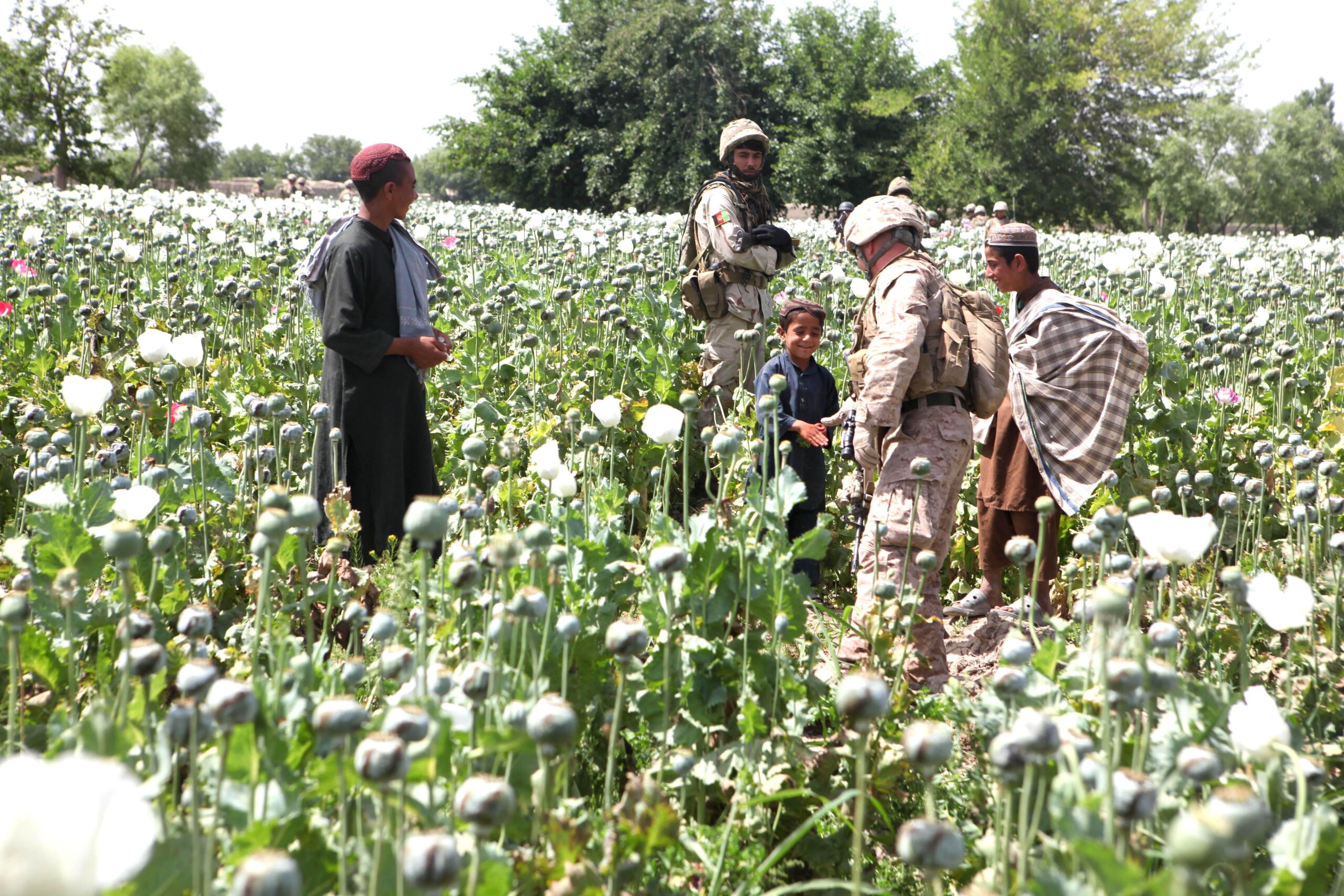
A U.S. Marine greeting local children working in an opium poppy field in Helmand Province, 2011. (ISAF / Wikimedia Commons / Public domain)
Chris Hedges: Well, Hamid Karzai, who was our puppet, and his brother controlled 90 percent of the heroin trade. And what Seth documents in his book is how Delta Force
and these other elite units came back, essentially, and started
dealing, they could ship the drugs over easily, started dealing drugs
all up and down the eastern seaboard.
Maureen Tkacik: And
he also documents this really systematic effort by the D.E.A. to
suppress the evidence that this is happening. So, they’re saying, hey,
look, we’ve tested the heroin and absolutely no heroin from Afghanistan
is coming into America. It’s all from Mexico or it’s all from here. And
those kinds of efforts that are made to conceal and distort what is
plainly happening that everybody knows is also really quite astonishing.
And
in the earlier days of the D.E.A., the agency had, I think, I’m not
sure, but it seems like the agency had a lot more folks working for it
who understood that their relationship with the C.I.A. was going to be
adversarial and that in order to like actually eradicate drugs, they
were gonna come up against some very powerful people within their own
government.
Like
that was sort of understood. I think by now the D.E.A. is just fully in
on it. But I felt a similar… When he’s been given a lot of interviews
describing how rigorously he fact-checked his thesis because the
propaganda was so… the certainty was among all of the chattering classes
that… it’s sort of like, “Maduro is a terrible, ruthless killer.” So
many people will tell you this with all the conviction you could muster,
but you don’t really ever know where it comes from.
And
in this case, it was the same. We accused the Taliban of being drug
traffickers. We were the drug traffickers. And as soon as the Taliban
takes charge, they get rid of the drug traffickers, and that’s why we
hate them. And that’s why they hate us.
Chris Hedges: Well,
we also occupied their country for 20 years. I want to talk about
Iran-Contra, which I did cover, because it was during the [Ronald]
Reagan administration, and Reagan was having trouble getting funds
approved. The Congress was more adversarial. Now it’s completely supine,
of course.
And so they set up this system of trafficking drugs to fund the Contras. Edén Pastora,
who was a renegade Contra leader operating out of Northern Costa Rica, I
knew him as well, was very involved in this, as was Félix Rodríguez,
who went by the pseudonym Max Gómez. But talk about that, because it’s
an important moment where you’re, in essence, really setting up this
infrastructure which continues.
Maureen Tkacik: Sure,
I would just like to say the infrastructure did predate Iran-Contra.
One of the reasons that these gentlemen have been so resilient in our
deep state is because they funded their own, they self-funded their
operations. So the Church Committee happens, the C.I.A. endures all of these scandals in the 1970s. You wanna do some covert ops, who are you gonna call?
This
was happening very early. Artime was getting in all of these scandals.
There was the woman whose husband had been murdered. There was also, he
had this wife who was maybe a bit of a prostitute. She’d been the
mistress of [Fulgencio] Batista and some other big dictators and she’d also posed for smut, lesbian smut.
And
so they send him off to Nicaragua and he sets up a base there. This is
sort of the start of this Black Ops regional dirty army that does a lot
of coke trafficking, but they also sort of form militias. And there’s
something called Operation Condor,
which actually turns out to be two things, but maybe they are the same.
And it supposedly started with Pinochet and the Argentinian…
Chris Hedges: It was three countries that united to fight communism, led perhaps by Argentina and Chile, right? Operation Condor?
Maureen Tkacik: Yes,
so that is the one that most people know and supposedly launched in
1975. But I was speaking to a scholar of this stuff who was saying,
really, it started with the murder of Che Guevara posing as a Bolivian
colonel. But Félix Rodríguez, this Bay of Pigs veteran and this sort of
long-time C.I.A. asset, and he also, he not only took Guevara’s Rolex,
but apparently he would brag that he had cut off his finger and sent it
to Fidel Castro.
C.I.A. agent Felix Rodriguez, left, with Che Guevara, center, before Guevara was executed in Bolivia, in 1967. (AP Photo / Courtesy of Felix Rodriguez / Wikimedia Commons / Public Domain)
So
I’ve been told that, this is in 1967, this is sort of the soft launch
of Operation Condor and the beginning of this kind of like cooperation
between all of these right-wing forces throughout Latin America.
There’s
another Operation Condor in Mexico that started in the early 70s that
was a crackdown. It was a specifically sort of D.E.A.-Mexican military
project that cracked down on marijuana farmers.
And
this was… I don’t know if they were the same thing but it had some of
the same effects. It was this real crackdown on left wing sort of
guerrilla movements, labor organizers. It was very easy for them to get
sort of rounded up in this blitz to eradicate marijuana throughout
Mexico.
So,
all together we see an enormous amount of cooperation. A lot of it is
orchestrated by the C.I.A. Pinochet at some point comes in and does some
things that the C.I.A. supposedly doesn’t know about.
I
read one interesting passage about how the C.I.A. wasn’t really on
board with Operation Condor. They weren’t entirely behind it and they
were very, very intent on making sure that it wasn’t headquartered in
Miami because that would have been the obvious place to headquarter such
a mission. But all of these guys funded their operations by trafficking
massive quantities of drugs.
And
this is something that like there is on the left, I think there’s this
sort of conventional wisdom. This public intellectual, Michael Massing, he’s got a Genius Grant, he’s written a few books on drug policy. And his line on Gary Webb was always like, it didn’t really matter that the C.I.A. was…
Chris Hedges: Let
me just interrupt for people that don’t know, Gary Webb was the
reporter who really broke the story, he did break the story of the
shipment of cocaine by Contras and C.I.A.-affiliated operatives into
American cities like Oakland. The press, the establishment press, worked
overtime, including, I was at the New York Times, to discredit him.
They
discredited him not by going down and checking on his reporting or
trying to re-report what he did, but by getting background briefings at
the C.I.A., and then he ultimately committed suicide.
Maureen Tkacik: Yes,
and with the benefit of hindsight, it is absolutely mind-blowing to
read any of the reports from Iran-Contra or a lot of the sources that I
used in this story just came from some of the collections of
declassified JFK files, right? Because these guys also were deeply
involved in that assassination and others. You can look up, anybody who
was a Cuban exile in Miami in the 60s, you can probably see if they’ve
had any prominence.
You
can probably find some information about them in these files. But
anyway, you look at the evidence that was just known by the end of the
80s about the C.I.A. involvement and the Contra involvement in drug
trafficking and this wasn’t new news. [Robert Parry, the founder of Consortium News, first broke the story for the Associated Press of Contra involvement in the drug trade.]
One
thing that Gary Webb really, a connection that he really nailed down
was the connection between the drug dealers that really first
popularized crack in the… I think Rick Ross was the name of one of them
in 1985, because when crack hit, I mean, it hit, it changed everything.
When I started writing for newspapers in the mid-late nineties, crack
was still people under the influence, it [was] the source of a lot of
violence in cities.
It
was a drug that really had just a devastating effect on already
devastated American cities. And he nailed down the connection between
this C.I.A., this just massive supply of cheap drugs and this
desperation to find new customers for this stuff. And to do that, they
had to go to people who had way less money than your average cocaine
consumer. And that’s what they did with it. This supply matters.
You
know, there’s this idea that the only way you can really fight drug
addiction and the scourge of illegal drugs is by working on the demand.
And there’s an element of truth to that. It makes a lot of sense. But
the fact is, our government’s run by drug traffickers, our institutions
of power. And that’s one of the reasons, look at what the Sacklers did. That was a supply side addiction epidemic.
And
we allow these things for whatever reason, but the evidence was
absolutely overwhelming that the C.I.A., that the highest levels of the
American intelligence apparatus were deeply involved. And even that,
there’s a documentary that came out recently that has a lot of quite a
few D.E.A. and other intelligence officers from the 1980s saying that
Félix Rodríguez himself, remember this character who assassinated Che
Guevara, Bay of Pigs veteran…
Chris Hedges: He didn’t actually assassinate Guevara. It was a Bolivian soldier shot, but he was there. Just as a small point, he was there.
Maureen Tkacik: He cut his finger off after he was dead.
Chris Hedges: Well,
no, he sent the… He is assassinated in the sense that they ordered,
they determined that there was no way Che was going to — he was captured
alive, of course — was going to live, but he didn’t actually pull the
trigger. They got some poor Bolivian soldier to do it. That’s just a
small footnote. You can read Jon Lee Anderson’sgreat book on Che.
Maureen Tkacik: Sorry.
But Félix Rodríguez is supposedly now, according to these folks, the
guy who actually ordered the murder, the torture and subsequent murder
of a D.E.A. agent who had sort of run afoul of it had become sort of a
whistleblower named Kiki Camarena.
Chris Hedges: This is Kiki Camarena.
Maureen Tkacik: Yeah,
and that is something that the cartels had long sort of been blamed
for. Now somebody tried to, I think, sue the Netflix documentarian for
defamation, but Félix Rodríguez, who’s still alive and still kicking,
indeed, recently hosted none other than Álvaro Uribe, former Colombian Prime Minister and good, good friend of Marco Rubio at a Bay of Pigs reunion event.
So
Félix Rodríguez is still a figure of some prominence in Miami. He’s got
a lot of blood on his hands, allegedly and not allegedly and by his own
testimony. But this is the type of guy who is sort of in the milieu of
this crew that ran this drug trafficking organization that Marco Rubio’s
brother-in-law had sort of ascended relatively to the number two spot
in essentially.
Another
thing that is interesting about Rubio’s own biography is that he has
said that his father trained at 18, I forget where, but he trained in
some training camp in Central America to — this would have been back in
the 40s — for a mission that never came off to overthrow and possibly
assassinate [Rafael] Trujillo,
the 30 year dictator of the Dominican Republic, who was sort of a
C.I.A. asset and then sort of a C.I.A. thorn in its side for many years.
So
I don’t know, that’s the only sign I’ve ever gotten that Rubio’s own
family was involved in any of this stuff. His family came to Miami
before the revolution, escaping Batista, and then subsequently would
move back and forth, trying to kind of scrape some money together
because I don’t think that anybody in his family was particularly
privileged.
Rubio
would change all that. And one thing that’s really also fascinating is
that the prosecutor that prosecuted his brother-in-law and the entire
drug trafficking organization, then the following year prosecuted Manuel Noriega
in a really fascinating trial that is another one of these unbelievable
windows into the C.I.A. involvement in drug trafficking.
Because
Noriega’s defense attorney, and a lot of evidence was suppressed in
this case, but his defense attorney was constantly cross-examining
various government witnesses saying like, okay, wasn’t the C.I.A. paying
Noriega this whole time as well? And Noriega claimed that he’d made $10
million cooperating with the C.I.A. over the years.
Panamanian military leader Manuel Noriega in a 1990 mugshot taken after his capture by U.S. forces. (U.S. Marshals Service / Wikimedia Commons / Public Domain)
They
never had any problem with him facilitating money laundering. And
that’s the other thing, so there’s a lot of rich history. That
prosecutor then, his wife, gives Rubio his first job literally like the
year after the indictment. I think that this might still be going on
during the trial or directly after the trial. The prosecutor’s wife, Ileana Ros[-Lehtinen], God, what is this last name? I can never… she’s a giant in the Congress in Miami, a good friend of Debbie Wasserman Schultz.
And her father was another Cuban exile deeply involved in Voice of America, I believe [he hosted shows for U.S.-funded Radio y Televisión Martí.]
But this congresswoman gave Marco Rubio an internship when he got out
of high school. They were very early on, it was decided that he was sort
of a preternatural political talent. His ties to drug traffickers never
stopped Marco Rubio, but he is very sensitive about the story, he
really went on a little jihad against Univision when they broke the story.
And
it’s just not really necessarily part of the conventional wisdom of who
he is. And I think it’s important not because I would accuse Marco
Rubio of being involved in drug trafficking himself, but understanding
the landscape of social capital, not to sound annoying, in Miami in the
1980s to understand how intertwined right-wing politics and drug
trafficking are in that community and how sort of this cognitive
dissonance is just something that everybody lives and breathes down
there.
Drug
crimes are only illegal when the wrong people are committing them and
that is something that is understood in, I think, throughout Latin
America that we don’t seem to comprehend.
Chris Hedges: Yeah, you succinctly write,
“Drug
traffickers who were allied with the C.I.A.’s ideological objectives
were protected, assisted and/or recruited as assets, while drug
traffickers who bribed or cooperated with leftists, crossed the Agency,
or outlived their usefulness were set up for prosecution or discarded.”
That’s
precisely correct. And I want to also mention, and you may have heard
this, but the common understanding is that Maduro, like [Claudia] Sheinbaum in Mexico, was fairly clean.
Maureen Tkacik: Oh
my god, yes. I have read the indictment against Maduro. There are
episodes, it’s a strange document. Nothing like the indictment of Juan
Orlando Hernández, which is very, it’s a classic indictment. The
evidence is there. You see it. I don’t know how the grand jury that… I
could see a Florida grand jury going for this, but it’s not very strong.
And
one of the things, one of the pieces of evidence, one of the passages
that was most bizarre to me was this, they have a section about toward
this 2013 drug bust, the biggest drug bust in the drug seizure in the
history of commercial air travel was 2013 Charles de Gaulle Airport,
probably one of the biggest, most busiest airports in the world — 1.3 tons of cocaine are found in 33 suitcases in this Air France flight from Caracas.
Immediately
Maduro, who is very new, Chavez has just died, he’s just taken over, he
has 25 airport security and sort of military officers who are involved
in the airport operation arrested. And then this strange British guy
gets arrested for having claimed on a wiretap that he was the actual
owner of the 1.3 tons of cocaine.
He’s
a very strange figure, supposedly a big crime boss in the U.K., but
he’s never really been written about before that except for some very
strange harassment charges, doesn’t seem particularly bright.
And
his lawyer claims, and then he later claims, no, he was just saying
that the coke was his on the wiretap to get them off his back. I don’t
understand. I’ve been meaning to kind of look into this a little bit
more closely, but it seems like it was some sort of setup, this whole
thing. It’s a very strange way to try and traffic cocaine, just putting
it into suitcases in a commercial airliner that is destined for the
busiest passenger airport in the world.
Something
about that is a little off to me. The whole thing is a little off. And
there was never any suggestion that Maduro had any involvement or
knowledge in that. And at the time, none of the investigations revealed
anything of the sort. But it’s used in this, it’s deployed in this
indictment as like this sign of what an unbelievably prodigious drug
trafficker Maduro is. So a lot of it is stuff like that.
There’s
something about Malaysian heating oil. The fact is that commerce itself
in Venezuela is mostly criminalized because of the severity of the
sanctions that we’ve imposed over the years on that country.
I
think that we almost feel like, as you see with the blowing up the oil
tankers, there’s this sense of entitlement that we have to sort of get
our way with Venezuela because we’ve literally criminalized most of the
economic activity that that country is involved in.
Another thing about Maduro is that he has two nephews who were
apparently arrested for narco trafficking a few years back and they sort
of claimed that they were framed.
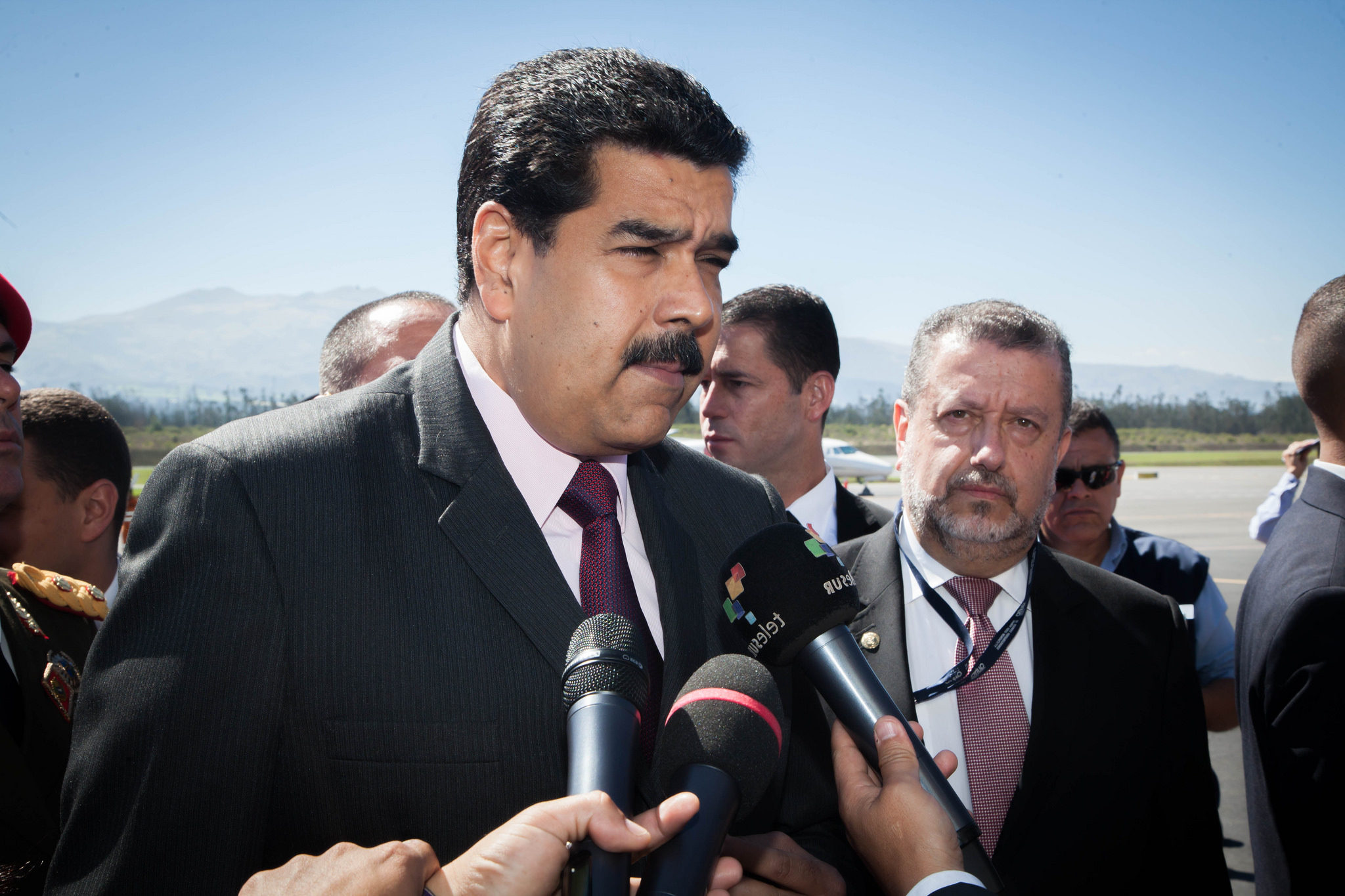
President Nicolás Maduro of Venezuela, 2016. (Cancillería del Ecuador via Flickr)
They
don’t seem particularly intelligent. They were trying to do a drug deal
so that they could get some money to win, I think, the 2018 election.
But this massive quantity of cocaine apparently was found in their room
at La Romana, I think that’s what it’s called. It’s a resort in the Dominican Republic. It’s owned by the Fanjul family.
One
Bob Menendez in 2013 claimed that he was, that the Fanjul family was
trying to set him up by sending whores to his villa at La Romana. It
just triggered something in my mind, like, hmm, I wonder if there’s
something to that. I wonder if that cocaine they found really belonged
to the narco-nephews. What’s really going on there? I wanna delve a lot
more deeply into this, but the indictment against him, I don’t
understand how they think…
Now,
Miami, if they were trying him in Miami, he might be a dead man. But in
New York, are they going to get a conviction in New York? On this? It
seems absurd.
Chris Hedges: I
want to go back to Rubio. You’re right, when Marco Rubio maligns the
efficacy of interdiction and other traditional law enforcement
approaches to mitigating narco trafficking in favor of military
operations, as he did in a recent speech on Trump’s speedboat bombings,
he is contradicting every empirical evaluation of drug war efficacy that
exists, yes.
But
he is also pining for a kind of Cold War-era blanket license to commit
dirty war in the name of some bigger goal. I was telling you before we
went into the interview that I was in Argentina at the end of the dirty
war.
Of
course, Carter had imposed some sanctions, which Reagan lifted, a
full-throated support under the Reagan administration for this junta,
which disappeared 30,000 of its own citizens. But it was common
knowledge that in police stations there were large industrial-sized
freezers full of cocaine.
And
when we talk about that dirty war, that nexus, which I think you
capture in the story between drug trafficking and the desaparecidos, the
killing of labor union leaders, student leaders, they’re intimately
intertwined.
Maureen Tkacik: There’s a book called Powderburns,
I believe, by a former D.E.A. agent, recalling his odyssey of being rat
fucked by C.I.A. guys in his efforts to combat drug trafficking in
Latin America in the 80s and early 90s. And at one point he recalls a
few conversations where somebody’s like, well, the war on drugs is
important, but the war on communism is even more important.
And
he’s like, where are you from? Because I’m from, I forget, I’m from a
city that’s been devastated by deindustrialization and now is being
brought to its knees by addiction. I’m not a fan of communism, but I
don’t really think that it’s a threat to my society. He just describes
how he was not able to understand that rationalization. But now we’re
using the drug war as its own, as the same sort of blanket license.
And
what it really is, I guess, is the same as the Cold War, is this
country has decided to threaten… This is another thing, there’s so much
talk about the oil curse, and it is true. I grew up, a lot of my youth I
spent in China, my dad was in the State Department, and I always
wondered, gosh, the Taiwanese, they had a lobby just like the Miami
lobby, the Cuba lobby and the Zionist lobby, they have the China lobby.
And
they trafficked drugs and they were bad guys and they were right-wing.
But at some point, maybe they switched drugs for bicycles and then
semiconductors and they started to build factories in China even though
they were technically at war and those two places are very
interdependent right now.
There’s
a lot of parallels that we like to make, but why were they allowed? Why
was China allowed to build an industrial economy? And why did we allow
our agents in Taiwan to facilitate this? Would they have been even able
to do it if they hadn’t sort of all done it in Taiwan first and they had
the language, yada yada? It’s just such a different story.
And
it seems like part of the benefit that China had other than its 1
billion people was that they didn’t have any resources to exploit. It
had to be their human capital, as they like to say in the business. But,
we do not allow countries with resources to nationalize those resources
in hopes of trying to nationalize the surpluses that they might bring
and then diversify their economy into something more sustainable.
The
resource curse is something that countless nations, obviously Libya,
Iran, Venezuela, Russia have all tried to sort of reverse and figure out
how to deal with and whenever they do, they feel our wrath. And so it
really pisses me off when pundits talk about the resource curse as
though it’s not really the sort of gratuitous sanctions for having the
temerity to threaten hegemony curse.
Chris Hedges
Well, that’s how [Allende] was overthrown in ‘73. It was at the service of Anaconda Copper. It’s how [Jacobo] Árbenz was overthrown in ‘54 in Guatemala on behalf of United Fruit.
As soon as you go, and that’s what’s happening with Venezuela. Trump,
unlike previous presidents, was quite open about it. It’s about the oil,
the largest reserves of oil in the world.
And the article is smart and good and people should read it, “The Narco-Terrorist Elite.” It’s in TheAmerican Prospect,
where Moe works as the investigative editor. It’s really a fine piece
of journalism and important for understanding what’s driving this policy
and who Marco Rubio is. Thank you, Moe.
Maureen Tkacik: Thank you so much. It’s an honor.
Chris Hedges: And
thanks to Victor [Padilla], Diego [Ramos], Max [Jones], Sofia
[Menemenlis] and Thomas [Hedges], who produced the show. You can find me
at ChrisHedges.Substack.com.
Chris Hedges is a Pulitzer Prize–winning journalist who was a foreign correspondent for 15 years for The New York Times, where he served as the Middle East bureau chief and Balkan bureau chief for the paper. He previously worked overseas for The Dallas Morning News, The Christian Science Monitor and NPR. He is the host of show “The Chris Hedges Report.”
La imagen que más
impacta de las descritas por los entrevistados en este documental es la
de uno de los directores más taquilleros de la historia del cine español
rebuscando en la basura en una calle madrileña. Lo llevó allí “la dama
blanca”, que es como se conocía a la heroína. En una entrevista de Ángel
Casas, Eloy de la Iglesia, demacrado y sin dientes, llegó a confesar
que en menos de tres años se había pulido todo su dinero metiéndoselo en
vena. Estamos hablando de la friolera más de cuarenta millones de
pesetas de la época.
Como recuerda uno de los entrevistados de este documental, Eduardo
Fuembuena, el mayor conocedor de la vida y obra de Eloy de la Iglesia,
fue el Partido Comunista de España el que le ayudó a no acabar en la
calle, aunque el cineasta llegó a dormir en bancos más de una noche.
Gracias a Juan Antonio Bardem y a Roberto Bodegas, el partido se
preocupó por la gestión de los derechos de autor de sus películas y
porque tuviese una asignación mensual. El problema fue que, aun así, el
director, amigo de la autodestrucción, se gastaba el dinero en las
tragaperras.
De la Iglesia no fue un ejemplo a seguir porque no solo cometió la
insensatez de caer en la heroína (se enganchó en 1983, al igual que su
amigo y coguionista Gonzalo Goicoechea), sino en romantizar al navajero
yonqui, que tenía muy poco de Robin Hood y supuso un auténtico infierno
para sus familias. Lo he vivido en persona, en el Bilbao de mi infancia,
espacio de las inolvidables El pico y su secuela.
Eloy de la Iglesia se presentaba como comunista, director de cine y maricón
A pesar de este romanticismo del yonqui y el quinqui, el director
nacido y criado en Zarauz, en una mansión de gente rica de origen
gallego que le pagó sus primeras películas (así de rica era) es uno de
los cineastas más rompedores y valientes que ha tenido el cine español
en toda su historia, un tipo marcado por su adicción, pero, como él
decía, también comunista, director de cine y maricón.
Eloy De la Iglesia era demasiado joven cuando tuvo la epifanía de
rodar películas y no tenía la edad requerida para entrar en la Escuela
de cine, pero tras estudiar cine en París logró rodar, en 1966, Fantasía… 3,
una cosita infantil que pudo hacer gracias a José María García
Escudero, director general de Cinematografía y Teatro que no era amigo
de la censura franquista y apoyó a muchos nuevos cineastas. Resulta más
que alucinante que un director que se hizo famoso por tratar en el cine
la homosexualidad, la violencia policial o el consumo de drogas debutase
adaptando cuentos de Hans Christian Andersen, los hermanos Grimm o L.
Frank Baum.
Algunos de los temas medulares de De la Iglesia (el sexo y la muerte y
la represión sexual, religiosa y política) no tardaron en aparecer en La semana del asesino,
guion que fue rechazado dos veces por la censura y sufrió 64 cortes en
el metraje, entre ellos escenas homosexuales entre Vicente Parra y
Eusebio Poncela (estamos hablando de 1972, imaginen la valentía que
supone hacer esta película tres años antes de la muerte del dictador).
La octava película del director vasco, Juego de amor prohibido,
sórdida y antiestética, también demostró que tras su truculencia y su
nada disimulado gusto por rodar con actores a veces demasiado jóvenes, a
De la Iglesia también le gustaba colar sus ideas políticas. En aquel
caso sobre la decadencia de la clase dirigente franquista y un enfermo
régimen que se desmoronaba.
Además de La criatura, filme sobre relaciones zoofílicas y de pésimo gusto, en 1977 estrenó Los placeres ocultos,
que por primera vez en el cine español presenta sin complejos a un
protagonista homosexual, un ejecutivo de banca con dinero al que le
gustan los jóvenes y sufre la represión que conlleva su condición
sexual. El filme, que tuvo el arrojo de mostrar los apestosos urinarios
públicos en los que se ligaba o se ejercía la prostitución, fue
secuestrada por la censura de la “ejemplar transición”, algo que produjo
las protestas en medios como el diario El País o la revista Fotogramas.
'El diputado' expone que también los partidos de izquierda podían ser reaccionarios
Con El sacerdote, también con Simón Andreu, De la Iglesia
quiso cruzar todos los límites para provocar aún más. La historia de un
sacerdote que no puede reprimir sus instintos sexuales es
sensacionalista y contiene escenas de un gusto atroz, como la de unos
niños desnudos practicando sexo con una oca. La crítica fue demoledora
con ella. Pedro Crespo habló en el ABC de “un nuevo engendro fílmico que
ensancha esa vía particular de cursilería melodramática,
erótico-sociológico-política que con tanta insistencia cultiva Eloy de
la Iglesia”. Fernando Trueba, en El País, escribió que “el mayor
defecto, el menos perdonable, del cine de De la Iglesia son sus
personajes. Arbitrariamente construidos para servir a los didácticos
objetivos de sus historias, sus personajes no resultan nunca creíbles,
verdaderos”. De la Iglesia, que era muy aficionado a poner motes,
despreciaba a Trueba y lo apodaba Bizconti por su estrabismo.
La biblia de su cine es El diputado, historia de un
militante clandestino de un partido de izquierdas durante el franquismo
que es elegido diputado en las elecciones de 1977, es víctima del
chantaje de ultraderechistas que lo amenazan con revelar su
homosexualidad y hasta su partido le da la espalda. Con ella De la
Iglesia, marxista, volvió a demostrar que le iba a la marcha porque
provocó hasta al PCE, del que era militante, como su amigo Juan Diego.
La cúpula del partido no vio con buenos ojos la película y hasta Juan
Antonio Bardem, que acabó participando en el filme, mostró su rechazo
inicial por ella, algo que fue duro para De la Iglesia, que entendía su
cine como un servicio al PC y una forma popular y directa de cambiar, en
la llamada transición, a la sociedad.
El diputado, que llegó a estrenarse en los Estados Unidos,
habla de que no solo hay que liberar al obrero, también al individuo. Su
protagonista, Roberto Orbea, lucha por su partido y país en la
clandestinidad, pero no puede expresarse en su privacidad ni mostrar
libremente su sexualidad, se le obliga a ser recto y heterosexual. La
película expone, en fin, que también los partidos de izquierda podían
ser reaccionarios.
Los últimos minutos de Eloy de la iglesia, adicto al cine
son inevitablemente tristes. En ellos Gaizka Urresti habla del otro gran
arrebato del director: el descubrimiento de José Luis Manzano. El
director mandó buscar a un chaval de la calle que cumpliera las
características físicas del Jaro y sus ayudantes encontraron en los
billares Victoria, regentados por chaperos, a Manzano, que entonces era
menor de edad.
Las películas de quinquis y el mundo marginal, pobre y atrasado de De la Iglesia no gustaban al PSOE
Como recuerda el director Antonio Hens en el documental, tras el
flechazo llegó el pacto: él lo mantendría y lo transformaría a lo Pigmalión,
pero a su vez llegó la bajada a los infiernos: los dos se engancharon a
la heroína y Manzano acabó muerto en el cuarto de baño del piso de De
la Iglesia por una sobredosis y con signos de violencia en su cuerpo
(algo que elude el documental). Según el informe forense, la causa de su
deceso “fue de naturaleza violenta, habiéndose encontrado los
principios de la heroína y de otros tóxicos en su sangre, orina y
órganos vitales”. Nadie sabe qué pasó aquella noche, pero fue algo
espantosamente oscuro.
A esta debacle personal se unió que las películas de quinquis y el
mundo marginal, pobre y atrasado de De la Iglesia no gustaban al PSOE,
que pretendía vender una España irreal, más progre y moderna. El PSOE
era más de Carlos Saura, miembro de la élite cultural y que ganó el Oso
de Oro a la Mejor película en el Festival de Berlín con Deprisa, deprisa,
la película quinqui oficial. Ese era el cine que quería subvencionar
Pilar Miró, primera mujer en ocupar la Dirección General de
Cinematografía que acabó, mediante la Ley Miró, con el cine que hacía
Eloy De la Iglesia, un cine antisistema, urgente y encima muy
taquillero. El PSOE buscaba un cine más académico y de prestigio, más La colmena o Luces de bohemia y menos Navajeros o La estanquera de Vallecas,
que De la Iglesia y Manzano (incapaz de vocalizar y doblado por
Fernando Guillén Cuervo) rodaron enganchados y en condiciones penosas.
Fue precisamente su amigo Guillén Cuervo quien le apoyó como pocos.
También lo hicieron Pedro Olea y Diego Galán, director del Festival de
San Sebastián, que en 1996 hizo una retrospectiva de su cine, diez días
que le hicieron, según sus palabras, recordar que estaba vivo. En esos
felices días también tomó la decisión de intentar volver a ponerse
detrás de una cámara y lo hizo siete años después con una pésima
película: Los novios búlgaros, protagonizada por Guillén Cuervo
y sobre los prostitutos del Este en el Madrid de principios de los
2000. Volvía a los chaperos y al lumpen, a su mundo.
Eloy de la Iglesia nunca tuvo nada que ver con el cine español oficial, académico, de festival
Eso sí: no consideró Los novios búlgaros su testamento,
quería seguir haciendo cine, pero murió a los 62 años por una
negligencia médica. Atrás dejaba un cine hecho con las tripas y la polla
más que con el cerebro, filmes tan punkis como técnicamente precarios.
Rodó sus películas demasiado deprisa, no fue un gran director de actores
y sus doblajes fueron infames, pero conoció como nadie al público y no
pretendió ir a Cannes, sino llenar butacas. Y nunca tuvo nada que ver
con el cine español oficial, académico, de festival. Solo por eso, y por
lo mosca cojonera que llegó a ser, Eloy de la Iglesia siempre nos caerá
bien.
Mientras
EEUU se inventa que Venezuela y Maduro son narcotraficantes, es bueno
recordar que en 1996, el periodista Gary Webb, expuso cómo la CIA
contrabandeaba cocaína desde Colombia para financiar a los terroristas
de la Contra en Nicaragua.
Después de desvelar esto al mundo, el
periodista Gary Webb fue encontrado muerto en su casa con 2 disparos en
la cabeza, asesinado por sicarios de la CIA por osarse a desvelar
secretos de estado, ¿quienes son la mafia narcotraficante?
Recordar
también que la CIA vendió esta droga (y sigue vendiéndola) en los
barrios pobres de EEUU, cantidades masivas de heroína y cocaína para
financiar sus invasiones imperialistas y al mismo estado, desencadenó la
epidemia de crack desde los 80 para acabar con los Panteras Negras,
hubo un récord de detenciones de jóvenes negros en los guetos y los
bebés negros nacían adictos al crack.