Según el Financial Times unos TRECE MIL MILLONES DE DÓLARES han desaparecido sin un papel, un informe, un balance, un indicio, una conjetura…
Luis Britto García, escritor y ensayista venezolano
Desde principios de año, para enterarnos de lo que ocurre en Venezuela debemos recurrir a fuentes fuera de Venezuela.
Así, para saber por qué los ingresos
propiedad de nuestro país por sus hidrocarburos y minerales no van a
parar al Tesoro ni al Presupuesto Nacional venezolanos, debí rastrear la
Executive Order 14373, “Safeguarding venezuelan oil revenue for the good of the american and venezuelan people”.
De acuerdo con ella, las cantidades
provenientes de la venta de estas propiedades nuestras son depositadas
en una cuenta del Tesoro de Estados Unidos, administrada por el
Presidente de ese país. El artículo donde reproduje la noticia fue
rechazado por los medios impresos nacionales.
Para descubrir el monto de esas riquezas venezolanas depositadas en el Treasure
estadounidense no me sirvieron de nada nuestro Presupuesto de la
Nación ni los informes del Banco Central de Venezuela o del Ministerio
de Finanzas.
Debí cumplir larga pesquisa en internet para localizar información del Financial Times según la cual desde enero hasta comienzos de julio de 2026, Estados Unidos ha ingresado 13 billones de dólares procedentes del petróleo venezolano (para los anglosajones un billón
es mil millones). Ni siquiera sometí la información a los medios
impresos; al igual que la presente, consta en mi blog
luisbrittogarcia.blogspot.com.
En fin, transcurridos meses a partir de la
invasión agravada con bombardeo, asesinato masivo de compatriotas y
cubanos y secuestro del Primer Mandatario y su señora esposa, supuse que
alguna fuente vernácula me informaría sobre el paradero de esas
demoledoras sumas. No encontré ni siquiera indicios. No tuve más
remedio que escudriñar los informes del estadounidense Council of Foreign Relations, para enterarme de que el misterio es total.
Citamos: “Los pueblos de Estados Unidos y
de Venezuela siguen en la oscuridad acerca de cómo la administración de
Trump está controlando miles de millones de dólares de los ingresos del
petróleo venezolano. Sin mecanismos contables ni un mapa de caminos
legible, Estados Unidos arriesga la consolidación de un régimen sucesor
corrupto”.
Y el Council prosigue : “Mientras
la Administración de Trump repetidamente ha calificado su control como
beneficioso para ambos países, no se ha revelado públicamente cuánto
petróleo venezolano ha vendido, cuanto ingreso ha recolectado por él, ni
cómo ha utilizado esos fondos desde que tomó el control de las
explotaciones petroleras del país (…)”.
En resumen, sumas provenientes de la venta de nuestros hidrocarburos que según el Financial Times
ascienden a unos TRECE MIL MILLONES DE DÓLARES han desaparecido sin un
papel, un informe, un balance, un indicio, una conjetura.
Marx decía que “todo lo sólido se
desvanece en el aire”. Desaparecieron y ya está. Con dichas sumas se
esfuman montos equivalentes de nuestra Educación, nuestra Salud,
nuestros Alimentos, nuestros Servicios Públicos, nuestra
Infraestructura, nuestra Cultura, nuestro aparato productivo, nuestras
Comunicaciones, nuestra Defensa, nuestro futuro.
Confirma el Council que “la
Administración tampoco ha presentado los acuerdos escritos que ha
concluido con el gobierno venezolano, comerciantes, compradores, bancos y
otras entidades involucradas en el proceso”.
Por si cupieran dudas, añade que “tanto
Rubio como el Secretario del Tesoro Scott Bessent se comprometieron por
separado a compartir una copia de los acuerdos escritos que rigen el
control de EEUU sobre las exportaciones venezolanas de petróleo, aunque
no está claro si dichas copias fueron entregadas al Congreso, y ni una
sola copia ha sido hecho pública”.
Por una buena razón: tales acuerdos,
arreglos o componendas, para ser válidos deben ser concertados de
acuerdo con lo pautado en la Constitución de la República Bolivariana de
Venezuela y las leyes del país, sin lo cual son nulos de toda nulidad y
carecen de efectos.
En resumen: todo es opacidad, misterio, tiniebla, enigma, negociado fuera del Horizonte de los Eventos. Dos detalles añade el Council
que confirman la inconmensurable atrocidad del latrocinio. Entre las
empresas que supuestamente habrían hecho tratos “transitorios” sobre los
bienes de Venezuela aparecen Trafigura y Vitold, ambas involucradas en
prácticas de soborno, ambas ancladas en acuerdos secretos que parecen
perpetuos.
El control sobre los ingresos de minerales
venezolanos no se limita a los hidrocarburos: el Secretario del
Interior Doug Burgum se habría asegurado de “$100 millones en oro”, y de
un trato por mil kilogramos de oro, asimismo para Trafigura. Por
nuestra parte, no sabemos el valor del uranio enriquecido gratuitamente
“retirado” del IVIC.
A la suite de l’enlèvement de
Nicolás Maduro, nous avons réalisé, en partenariat avec le collectif
Becs Rouges, un entretien avec Thierry Deronne, cinéaste, universitaire
spécialiste du Venezuela. Nous revenons avec lui sur la situation du
pays.
Positions revue : Chávez et Maduro sont les figures
de proue de la révolution bolivarienne au Venezuela, et ils n’ont pas
construit tout seuls la révolution bolivarienne. Les quartiers et la
population se sont mobilisés autour de structures appelées « communes »,
qui sont des instances parallèles à celle du gouvernement. Comment se
sont-elles mises en place ? Quelles ont été les erreurs des premières
heures ? Qu’en est-il de la démocratie de base : participation des
communes, délégation ?
Thierry Deronne : Au Venezuela, le mot « commune »
signifie « autogouvernement populaire ». Construire un pouvoir
populaire, changer les consciences, sortir de la culture clientéliste,
paternaliste, capitaliste, ne se fait pas en un jour. On est passé de
structures fragmentaires centrées sur des revendications spécifiques
(comme les comités de terre qui visaient au début des années 2000 la
légalisation des zones invisibles sur les cartes officielles) à des
structures chargées d’enjeux sociaux et économiques de plus en plus
larges : ce sont les communes. Elles fédèrent les conseils communaux
locaux, afin de résoudre des défis structurels sur un territoire plus
vaste.
La política estadounidense
de crear cuellos de botella para mantener a otros países dependientes
del petróleo bajo su control es uno de los principales medios de Estados
Unidos para generar inseguridad en otros países
Irán (1953), Irak (2003), Libia
(2011), Rusia (2022), Siria (2024) y ahora Venezuela (2026). El
denominador común subyacente a los ataques y sanciones económicas
estadounidenses contra todos estos países es la instrumentalización del
comercio petrolero mundial. El control del petróleo es uno de sus
métodos clave para lograr un control unipolar sobre el amplio comercio
mundial y los acuerdos financieros dolarizados.
La perspectiva de que los países
mencionados utilicen su petróleo para su propio beneficio y para fines
diplomáticos representa la mayor amenaza para la capacidad general de
Estados Unidos de utilizar el comercio petrolero para hacer cumplir los
objetivos de su diplomacia. Todas las economías modernas necesitan
petróleo para abastecer sus fábricas, calentar e iluminar sus hogares,
producir fertilizantes (a partir del gas) y plásticos (a partir del
petróleo) y abastecer su transporte.
El petróleo bajo control de Estados
Unidos o de sus aliados (British Petroleum, Shell de Holanda y hoy la
OPEP) ha sido durante mucho tiempo un potencial punto de
estrangulamiento que los funcionarios estadounidenses pueden utilizar
como palanca contra países cuyas políticas consideran adversas a los
designios estadounidenses: Estados Unidos puede hundir las economías de
esos países en el caos cortando su acceso al petróleo.
Una «guerra de civilización» en beneficio económico de Estados Unidos
El objetivo primordial de la
diplomacia estadounidense actual —en lo que sus estrategas denominan una
guerra de civilizaciones contra China, Rusia y sus posibles aliados del
BRICS— es bloquear la retirada de países de la economía mundial
controlada por Estados Unidos y frustrar el surgimiento de una
agrupación económica centrada en Eurasia. Sin embargo, a diferencia de
la posición de Estados Unidos al final de la Segunda Guerra Mundial,
cuando era la principal potencia económica y monetaria del mundo, hoy
cuenta con pocos incentivos positivos para atraer a países extranjeros a
una economía mundial centrada en Estados Unidos, en la que, como ha
dicho el presidente Trump, Estados Unidos debe ser el ganador en
cualquier acuerdo de comercio e inversión exterior, y los demás países
los perdedores.
Fue para aislar a Rusia, y tras ella a
China e Irán, que el presidente Trump utilizó sus aranceles del Día de
la Liberación del 2 de abril de 2025 para presionar a los líderes
alemanes y de la UE a abstenerse voluntariamente de importar más energía
de Rusia 1 , a pesar del hecho de que partes del gasoducto Nord Stream 2
todavía estaban operativas.
La aceptación previa de Alemania y la
UE de la destrucción de los gasoductos Nord Stream en febrero de 2022 es
testimonio de la capacidad de los diplomáticos estadounidenses para
obligar a los países a unirse, en su propio detrimento, a las alianzas
militares de la Guerra Fría de Estados Unidos y seguir las políticas que
establece. La desindustrialización y la pérdida de competitividad de
Alemania desde que se bloqueó su comercio de petróleo y gas con Rusia
fue el sacrificio que Estados Unidos le exigió (y a la UE) en su afán
por aislar y dañar las economías rusa y china (y también para generar
ingresos adicionales por exportación de GNL para sí mismo, sin duda).
Una característica fundamental de la
política de seguridad nacional estadounidense es su capacidad para
impedir que otros países protejan y actúen en beneficio de su propia
seguridad e intereses económicos. Esta asimetría se ha arraigado en la
economía mundial desde el final de la Segunda Guerra Mundial, cuando
Estados Unidos contaba con un enorme apoyo económico para las economías
europeas devastadas por la guerra. Sin embargo, el poder coercitivo
estadounidense actual se sustenta principalmente en sus amenazas de
causar daños y caos mediante la creación y explotación de cuellos de
botella o, como último recurso, el bombardeo de países más débiles para
obligarlos a obedecer.
Esta influencia destructiva es la
única herramienta política que le queda a una economía estadounidense
que se ha desindustrializado y ha caído en una deuda externa de una
magnitud que ahora amenaza con acabar con el papel monetario dominante y
lucrativo del dólar.
Al final de la Segunda Guerra Mundial,
el dinero era el principal estrangulamiento de las economías
occidentales. El Tesoro estadounidense estaba a punto de aumentar sus
reservas de oro hasta el 80% del oro monetario mundial, del cual
dependía la expansión financiera exterior bajo el patrón dólar/oro para
los pagos internacionales, vigente hasta 1971.
Dado que la mayoría de los países
carecían de oro monetario y necesitaban préstamos para financiar sus
déficits de comercio exterior y balanza de pagos, los diplomáticos
estadounidenses recurrieron al Fondo Monetario Internacional y al Banco
Mundial para otorgar préstamos con condiciones que impusieron políticas
de privatización proestadounidenses, impuestos regresivos y la apertura
de las economías extranjeras a la inversión estadounidense. Todo esto se
ha convertido en parte del sistema dolarizado del comercio
internacional y de la política monetaria que lo financia.
Además del dinero, el petróleo se ha
convertido en una necesidad internacional fundamental y, por ende, en un
posible cuello de botella. También ha sido durante mucho tiempo un
pilar de la balanza comercial estadounidense (junto con las
exportaciones de granos) y ha sido el principal soporte del papel
dominante del dólar en las finanzas desde 1974, cuando los países de la
OPEP cuadruplicaron sus precios del petróleo y llegaron a un acuerdo con
funcionarios estadounidenses para invertir sus ingresos de exportación
mediante la compra de bonos del Tesoro estadounidense, valores
corporativos y depósitos bancarios, bajo la advertencia de que no
hacerlo se consideraría un acto de guerra contra Estados Unidos . 2 El
resultado fue la creación del mercado del petrodólar, que se convirtió
en un pilar de la balanza de pagos estadounidense y, por ende, de la
fortaleza del dólar.
Desde 1974, las autoridades
estadounidenses han buscado no solo mantener el comercio mundial de
petróleo y otras materias primas cotizadas en dólares, sino también que
los excedentes de petróleo y otras exportaciones se presten a (o
inviertan en) Estados Unidos. Este es el tipo de «recompensa» que Donald
Trump ha estado negociando con países extranjeros durante el último año
como condición para permitirles mantener el acceso al mercado
estadounidense para sus productos.
El ejemplo más reciente de esta
insistencia fue el anuncio del Departamento de Energía el 6 de enero de
que la administración Trump permitiría a Venezuela exportar entre 30 y
50 millones de barriles de petróleo, por un valor de hasta 2.000
millones de dólares, y que esto “continuaría indefinidamente” de forma
selectiva, sujeto a una disposición clave: “Los ingresos se liquidarán
en cuentas controladas por Estados Unidos en ‘bancos reconocidos
mundialmente’ y luego se desembolsarán a las poblaciones de Estados
Unidos y Venezuela a ‘discreción’ de la administración Trump”. 3
EE.UU. exige: privilegios prioritarios en el comercio mundial de materias primas vitales
En septiembre de 1973, un año antes de
la revolución de precios de la OPEP, Estados Unidos derrocó al
presidente electo de Chile, Salvador Allende. El problema no fue la
«chilenización» de su industria cuprífera. Ese plan, de hecho, había
sido propuesto por las compañías cupríferas estadounidenses Anaconda y
Kennecott. Consideraban que la compra negociada de las empresas
estadounidenses contribuiría a elevar el precio mundial del cobre. Esto
creó un marco de precios que permitía a las empresas aumentar las
ganancias de su propia minería y refinación en Estados Unidos. Este fue
el mismo principio que llevó a las petroleras a aceptar las
nacionalizaciones y el aumento de precios de la OPEP en 1974.
La condición clave del acuerdo chileno
sobre el cobre era que su cobre se vendería a empresas estadounidenses
como primera opción, al precio chileno establecido. Las empresas
cupríferas estadounidenses necesitaban esta garantía para asegurar a sus
clientes de cableado eléctrico, armas y otras aplicaciones importantes
un suministro continuo. Este derecho de preferencia era una concesión
que no implicaba un sacrificio económico por parte de Chile. Sin
embargo, Allende insistió en que esta concesión violaba la soberanía
chilena. Era una exigencia innecesaria para el interés nacional de
Chile, pero Allende se mantuvo firme y fue derrocado.
En el caso de Venezuela, lo que más
molesta a los responsables de seguridad nacional de EE. UU. es que ha
estado abasteciendo el 5% de las necesidades petroleras de China.
También abastecía a Irán y Cuba, aunque Rusia la ha reemplazado cada vez
más como proveedor de estos dos países desde 2023. Esta libertad de
Rusia y Venezuela para exportar petróleo ha debilitado la capacidad de
los funcionarios estadounidenses para utilizar el petróleo como arma
para presionar a otras economías, amenazándolas con la misma retirada de
energía que ha destrozado la industria y los niveles de precios
alemanes. Por lo tanto, este suministro de petróleo fuera del control de
EE. UU. se consideró una infracción del ordenamiento jurídico
estadounidense.
Para empeorar las cosas, Venezuela
anunció en 2017 que comenzaría a fijar el precio de sus exportaciones
petroleras en divisas distintas del dólar, lo que ponía en peligro la
práctica del mercado del petrodólar. Y a medida que China se convertía
en inversionista en la industria petrolera venezolana, se hablaba de que
el presidente Maduro comenzaría a cotizar sus exportaciones petroleras
en yuanes chinos (de forma similar a lo que Zambia acaba de hacer con
sus exportaciones de cobre). Maduro dejó claro el desafío que estaba
planteando. Ya en 2017 había anunciado que su objetivo era acabar con el
«sistema imperialista estadounidense» .
La economía mundial actual la gobiernan reglas estadounidenses no escritas, no la Carta de las Naciones Unidas
La diplomacia estadounidense no se
siente segura a menos que pueda generar inseguridad en otros países, y
ve amenazada su libertad de acción si se permite a otros países decidir
libremente con quién comerciar y qué hacer con sus ahorros.
La política exterior estadounidense de
crear cuellos de botella para mantener a otros países dependientes del
petróleo bajo control estadounidense (no del petróleo suministrado por
Rusia, Irán o Venezuela) es uno de los principales medios de Estados
Unidos para generar inseguridad en otros países. Sin embargo, esta
política no se ha plasmado en documentos públicos. Hasta las
contundentes declaraciones de Trump y sus asesores la semana pasada, los
diplomáticos estadounidenses parecían haber tenido reparos en declarar
abiertamente este y otros principios fundacionales similares del orden
basado en normas de Estados Unidos.
La razón de esta reticencia fue que
estos principios son antitéticos al derecho internacional (y también a
los principios de libre mercado, a los que Estados Unidos se ha adherido
hasta ahora, al menos en su retórica). El ataque militar estadounidense
a Venezuela y el secuestro del presidente Maduro son el ejemplo más
reciente de ello. Si bien los líderes estadounidenses consideran su
agresión un ejercicio permisible de sus principios de orden basado en
normas, constituye una flagrante violación —de hecho, un repudio— del
derecho internacional, en particular del Artículo 2(4) de la Carta de
las Naciones Unidas, que establece, en efecto, que «una nación no podrá
usar la fuerza en el territorio soberano de otro país sin su
consentimiento, un motivo de legítima defensa o la autorización del
Consejo de Seguridad de la ONU». 5
Por sorprendente que parezca, Estados
Unidos justifica con frecuencia sus agresiones y amenazas militares
alegando legítima defensa. El columnista del Financial Times ,
Gideon Rachman, por ejemplo, informa que «EE. UU. cree que su propia
seguridad nacional se vería en peligro si la industria taiwanesa de
semiconductores cayera en manos de China, o si Pekín controlara el
transporte marítimo que pasa por el Mar de China Meridional». 6
Estados Unidos parece ser el país más
amenazado y vulnerable del mundo, muy alejado de su antiguo poder. El
propio Trump parece vivir con miedo, e incluso cita la ubicación
geográfica de Groenlandia como una amenaza para la seguridad nacional
estadounidense: «Necesitamos a Groenlandia desde el punto de vista de la
seguridad nacional», declaró a los periodistas a bordo del Air Force
One el 4 de enero. «Groenlandia está repleta de barcos rusos y chinos. 7
Ha prometido ocuparse de Groenlandia en los próximos dos meses.
Y los líderes de la UE respaldan a
Trump como el máximo protector de Europa contra tales amenazas. El
presidente de Letonia ha sugerido, con gran acierto, que las «legítimas
necesidades de seguridad de EE. UU.» deben abordarse en un «diálogo
directo» entre EE. UU. y Dinamarca. 8 «Groenlandia debería formar parte
de Estados Unidos», declaró Stephen Miller, subjefe de Gabinete de Trump
para Política y Seguridad Nacional. «El presidente ha sido muy claro al
respecto; esa es la postura oficial del gobierno estadounidense».
Descartando la idea de que la toma de
Groenlandia implique una operación militar, advirtió que «nadie va a
luchar militarmente contra Estados Unidos por el futuro de Groenlandia».
9
Y menos aún los daneses, al parecer.
El aspecto más siniestro de las amenazas de Trump de anexar Groenlandia a
Estados Unidos a principios de 2026 fue la intención estadounidense,
apoyada por la OTAN, de bloquear el acceso al Ártico desde el Atlántico
Norte «a ambos lados de la brecha entre Groenlandia, Islandia y el Reino
Unido por la que deben pasar los buques rusos o chinos para entrar en
el Atlántico Norte». 10
Un portavoz de la OTAN se refirió a
los comentarios hechos por el secretario general Mark Rutte el [6 de
enero] en los que dijo que «la OTAN colectivamente… tiene que asegurarse
de que el Ártico se mantenga seguro». 11
El propio Rutte dijo a CNN que «Todos
[los miembros de la OTAN] estamos de acuerdo en que los rusos y los
chinos son cada vez más activos en esa zona», lo que no dejó lugar a
dudas de que mantener el océano Ártico «seguro» significa «libre» del
transporte marítimo chino y ruso que ambos países han estado trabajando
para desarrollar con el fin de acortar las rutas y los tiempos de
navegación.
Un editorial del Wall Street Journal
respalda la afirmación de que Estados Unidos necesita defenderse de los
países que permanecen independientes de su control. Señalando que
«Estados Unidos también alegó legítima defensa para arrestar al dictador
panameño Manuel Noriega», el periódico argumenta que el derrocamiento
militar es «la única defensa contra los delincuentes globales». 12
Más concretamente, advierte que sería
una ilusión idealista, pero anacrónica, imaginar que el derecho
internacional realmente rige las acciones de las naciones. «Como si
Moscú y Pekín no pisotearan ya el derecho internacional cuando este se
interpone en su camino», se burla, desestimando la relevancia del
derecho internacional por haberse convertido en «el mejor amigo de un
tirano». 13
El derecho de gentes siempre ha estado
sujeto, en última instancia, al uso de la fuerza y al principio de la
ley de la fuerza. El asesor de Trump, Stephen Miller, explicó su
filosofía en una entrevista con CNN:
Vivimos en un mundo, en el mundo real…
que se rige por la fuerza, que se rige por la fuerza, que se rige por
el poder. Estas son las leyes de hierro del mundo desde el principio de
los tiempos. 14
Los diplomáticos estadounidenses
podrían simplemente encogerse de hombros y preguntar cuántas tropas
tiene la ONU. No tiene ninguna, y las resoluciones del Consejo de
Seguridad, en cualquier caso, están sujetas al veto estadounidense.
Estados Unidos simplemente ignora las disposiciones de la Carta de la
ONU, como el mundo acaba de ver con el secuestro del jefe de Estado
venezolano. Son las normas estadounidenses las que sirven como ley
operativa a la que están sujetos otros países, al menos aquellos en la
órbita comercial, financiera y militar estadounidense.
Trump no tiene reparos en reconocer el
principio operativo que se aplica a su última diplomacia internacional:
«Queremos el petróleo de Venezuela». 15 Ya había confiscado petróleo en
tránsito de petroleros que salían de Venezuela el mes pasado. Y ha
anunciado que si la presidenta interina de Venezuela, Delcy Rodríguez,
no acepta voluntariamente ceder el control de su petróleo, el ejército
estadounidense entregará sus reservas petroleras a empresas
estadounidenses y traerá a un nuevo cliente, cleptócrata o dictador,
para que gobierne el país en nombre de los intereses estadounidenses.
Cuando el Departamento de Estado de
EE. UU. presionó a los países de la OPEP para que reciclaran sus
ganancias de exportación de petróleo en valores en dólares
estadounidenses en 1974, los líderes de la OPEP estaban dispuestos a
hacerlo, porque Estados Unidos era, por mucho, la principal economía
financiera del mundo en ese momento. Aún domina el sistema financiero
basado en el dólar, pero ya no tiene su antiguo poder industrial, y
acaba de recortar su ayuda exterior y su membresía en la Organización
Mundial de la Salud y otras agencias de ayuda de la ONU.
En lugar de apoyar el crecimiento en
otras economías, su fuerza diplomática ahora se basa en su capacidad
para interrumpir su comercio y crecimiento económico. Y su poder
industrial en declive es lo que ha hecho que la acción estadounidense
contra Venezuela sea tan urgente, con su agresión militar y amenazas
constantes contra ese país como parte de su intento de disuadir a los
países de romper con las reglas no escritas del control unipolar
estadounidense del comercio y los pagos internacionales mediante la
desdolarización de sus relaciones comerciales y monetarias.
También existe una apropiación de
recursos. Stephen Miller, el principal asesor de Trump mencionado
anteriormente, declaró sin rodeos que «los países soberanos no obtienen
soberanía si Estados Unidos quiere sus recursos». Sus comentarios
siguieron a una declaración igualmente contundente del embajador
estadounidense Michael Waltz en una reunión de emergencia del Consejo de
Seguridad de la ONU: «No se puede seguir teniendo las mayores reservas
energéticas del mundo bajo el control de adversarios de Estados Unidos».
16
El principio legal estadounidense es
que «la posesión es nueve décimas partes de la ley». Y la ley vigente en
el presente caso es la de Estados Unidos, no la de Venezuela ni la de
las Naciones Unidas. Una serie de otros principios están en juego,
encabezados por el derecho de legítima defensa mencionado anteriormente
bajo el permiso estadounidense de «Defensa propia».
La historia de portada para el ataque
de Trump a Venezuela (probado por los medios de comunicación de Fox News
y encuestas) es que Venezuela amenaza a Estados Unidos con cocaína y
otras drogas. O al menos con drogas que no están coordinadas por la CIA y
el ejército estadounidense, como se ha documentado desde Vietnam hasta
Afganistán y Colombia. Sin embargo, la acusación judicial contra Maduro
no hizo referencia a las afirmaciones de Trump sobre un «Cártel de los
Soles» que supuestamente él encabezaba, sino que citó principalmente
cargos no relacionados sobre su porte de una ametralladora y cargos
similares inaplicables a un jefe de estado extranjero.
No hubo acusación formal contra Maduro
por sus verdaderos delitos a ojos de Estados Unidos: amenazar la
capacidad estadounidense de controlar el petróleo de su país y su
comercialización, y su intención de fijar el precio del petróleo
venezolano en yuanes y otras monedas distintas del dólar, y utilizar las
ganancias de sus exportaciones petroleras para pagar a China por sus
inversiones en su país.
La analogía adecuada para los falsos
cargos de narcotráfico contra Maduro es la falsa afirmación —utilizada
para justificar la invasión estadounidense de Irak en 2003— de que
Saddam Hussein trabajaba para obtener armas de destrucción masiva. Eso
bastó para desvirtuar el respeto por el secretario de Estado Colin
Powell tras su discurso del 5 de febrero de 2003 ante las Naciones
Unidas. Pero bajo el principio estadounidense de «defensa propia»,
Estados Unidos tenía motivos para sentirse amenazado por el intento de
Venezuela de tomar el control de su comercio petrolero y, de hecho, de
comerciar con los adversarios designados de Estados Unidos: China, Rusia
e Irán.
La agresión estadounidense en
respuesta a esa amenaza fue apoyada por el principio estadounidense que
permite a los propietarios de viviendas o a los policías matar a
quienquiera que piensen que pueda ser una amenaza, por muy subjetivo o
una excusa posterior que pueda ser.
Si bien se justifica por estos
principios del orden basado en normas estadounidenses, la reciente
instrumentalización del comercio petrolero por parte de Trump ha
implicado, como se mencionó anteriormente, el repudio por parte de
Estados Unidos de principios fundamentales del derecho internacional,
incluido el derecho del mar.
Antes de su ataque militar a Caracas y
el secuestro del presidente Maduro, su embargo a las exportaciones
petroleras venezolanas (a cualquier comprador, excepto a las compañías
petroleras estadounidenses) y la incautación de petroleros que
transportaban el petróleo del país fueron especialmente atroces, por no
mencionar su bombardeo de barcos pesqueros no identificados y otras
embarcaciones frente a las costas de Venezuela, asesinando a sus
tripulaciones sin previo aviso.
Otra víctima del énfasis
estadounidense en instrumentalizar el comercio mundial de petróleo y
energía es el medio ambiente. En su afán por hacer que el resto del
mundo dependa del petróleo y el gas bajo su férreo control y el de sus
aliados, Estados Unidos lucha para impedir que otros países
descarbonicen sus economías en un intento por evitar una crisis
climática y sus fenómenos meteorológicos extremos. Por ello, Estados
Unidos se opone al Acuerdo Climático de París y apoya una política
«verde» para sustituir los combustibles fósiles por energía eólica y
solar.
El problema para Estados Unidos es que
la energía eólica y solar ofrecen una alternativa al petróleo, que
Estados Unidos busca controlar. La eliminación gradual del petróleo no
solo eliminaría un pilar de la balanza comercial estadounidense, sino
que privaría a sus estrategas de la capacidad de apagar las luces y la
calefacción de los países cuyas políticas se oponen.
Y para empeorar las cosas, China ha
tomado la delantera en la tecnología de energías renovables, incluyendo
la producción de paneles solares y aspas de molinos de viento. Esto se
considera una gran amenaza, ya que aumenta el riesgo de que otras
economías se independicen del petróleo. Mientras tanto, la oposición
estadounidense a combustibles distintos del petróleo bajo su control ha
causado un daño repercutido en la propia economía estadounidense, al
bloquear su propia inversión en energía solar y eólica.
La administración Trump ha sido
particularmente agresiva, no solo bloqueando las iniciativas extranjeras
para reducir los combustibles fósiles, sino también las alternativas
estadounidenses. «El primer día de su segundo mandato presidencial, el
Sr. Trump emitió una orden ejecutiva que suspende todo arrendamiento de tierras y aguas federales para nuevos parques eólicos.
Desde entonces, su administración ha
perseguido a los parques eólicos que habían recibido permisos de la
administración Biden y que estaban en construcción o a punto de entrar
en funcionamiento, utilizando explicaciones variables». 17 «Ha
suspendido los arrendamientos de todos los proyectos eólicos marinos en
un nuevo ataque al sector», alegando motivos de seguridad nacional. 18
Lo que hace aún más sorprendente esta
medida contra las fuentes de energía alternativas es la escasez de
electricidad proyectada en Estados Unidos, que se anticipa será causada
por la creciente demanda de los centros de computación de IA, en
circunstancias en las que Estados Unidos deposita grandes esperanzas en
la inteligencia artificial (IA). Además de las rentas derivadas de sus
recursos petroleros, los estrategas estadounidenses esperan aumentar las
rentas monopolísticas de Estados Unidos a expensas de otros países
mediante sus empresas de tecnología de la información, plataformas de
internet y (así esperan) su dominio en IA.
El problema es que la IA requiere una
enorme cantidad de energía para operar sus computadoras. Sin embargo, la
tendencia estadounidense en la producción de energía se ha mantenido
estancada durante la última década, y la inversión en nuevas
instalaciones energéticas es un proceso largo y burocrático (de ahí la
escasez de energía proyectada mencionada anteriormente).
Esto contrasta marcadamente con el
enorme aumento de la producción de electricidad en China, en gran medida
como resultado de la producción intensiva de paneles solares y molinos
de viento, en la que ha establecido una amplia ventaja tecnológica,
mientras que la práctica estadounidense ha evitado esta fuente de
energía por considerarla «no inventada aquí» y, más fundamentalmente,
por tener el potencial de socavar su intento de hacer que el mundo
dependa del petróleo que controla.
Las principales exigencias del orden basado en normas de Estados Unidos en relación con el petróleo son:
El control del comercio mundial del petróleo seguirá siendo un privilegio de Estados Unidos.
El comercio del petróleo debe cotizarse y pagarse en dólares estadounidenses
La regla del petrodólar
Se deben desalentar las
alternativas energéticas “verdes” al petróleo y negar el fenómeno del
calentamiento global y el clima extremo.
Ninguna ley se aplica ni limita las normas o políticas de EE. UU.
Notas:
1. Contribuyó a la presión la amenaza
de Trump de cortar el apoyo militar estadounidense ante escenarios de
pesadilla de ocupación militar rusa de Europa occidental.
2. La clave para controlar el petróleo
no residía, por lo tanto, en la propiedad directa de pozos y
refinerías, ni siquiera en su fijación de precios, sino en la capacidad
de amenazar militarmente a los países de la OPEP para controlar cómo
gastarían o invertirían sus ingresos por exportaciones. No tengo ninguna
referencia de que esta amenaza de agresión militar se haya expresado
explícitamente por escrito, pero me lo dijeron en mis conversaciones
personales con funcionarios del Tesoro y del Departamento de Estado en
la Casa Blanca cuando Herman Kahn me llevó allí para tratar precisamente
este asunto. Había sido especialista en el Chase Manhattan Bank en la
balanza de pagos y las relaciones internacionales de la industria
petrolera, y trabajé en el Hudson Institute de 1972 a 1976 con un
contrato con la Casa Blanca.
3. Associated Press, “ El Departamento de Energía de Trump describe nuevas políticas para el petróleo venezolano
”, 7 de enero de 2026. No se especifica un plazo para estos 2.000
millones de dólares en exportaciones de petróleo, ni cómo se dividirá el
pago entre Estados Unidos y Venezuela. Trump simplemente declaró en su
blog @realDonald Trump que el petróleo venezolano sancionado “se venderá
a su precio de mercado, y ese dinero será controlado por mí, como
presidente de los Estados Unidos de América… Se transportará en barcos
de almacenamiento y se transportará directamente a los muelles de
descarga en Estados Unidos”, desde donde una parte podría, según
prometió, venderse a China.
4. “He decidido empezar a vender
petróleo, gas, oro y todos los demás productos que Venezuela vende con
nuevas monedas, incluyendo el yuan chino, el yen japonés, el rublo ruso,
la rupia india, entre otras”, declaró [Maduro] durante una transmisión
televisiva, afirmando que “una economía libre del sistema imperialista
estadounidense es posible”. Yahoo Finance, “Venezuela venderá petróleo
en monedas distintas del dólar”, 8 de septiembre de 2017. https://sg.finance.yahoo.com/news/venezuela-sell-oil-currencies-other-034439095.html
5. Charlie Savage, “¿Puede Estados
Unidos ‘gobernar’ Venezuela legalmente tras la captura de Maduro? Esto
es lo que debe saber”, The New York Times , 3 de enero de 2026.
El texto de la Carta establece que: “Todos los Miembros se abstendrán,
en sus relaciones internacionales, de recurrir a la amenaza o al uso de
la fuerza contra la integridad territorial o la independencia política
de cualquier Estado, o en cualquier otra forma incompatible con los
Propósitos de las Naciones Unidas”. El artículo mencionado señala que
“[a]rrestar a alguien para someterlo a juicio, sin embargo, es una
operación de aplicación de la ley, no defensa propia. En 1989, la
mayoría del Consejo de Seguridad de las Naciones Unidas votó a favor de
condenar la invasión de Panamá, aunque Estados Unidos vetó la resolución . La Asamblea General de la ONU votó 75 a 20
para considerarla una flagrante violación del derecho internacional y
de la independencia, la soberanía y la integridad territorial de los
Estados”.
6. Gideon Rachman, “El problema con la Doctrina Donroe”, Financial Times , 6 de enero de 2026.
7. Rebecca Elliott, “Los objetivos de Trump sobre el flujo de petróleo no son tan fáciles”, The New York Times
, 6 de enero de 2026. “Necesitamos Groenlandia, absolutamente”, le dijo
Trump a Michael Scherer, “Trump amenaza al nuevo líder de Venezuela con
un destino peor que el de Maduro”, The Atlantic , 4 de enero de 2026.
8. Eldar Mamedov, “Europa silba más allá del cementerio venezolano”, Responsible Statecraft
, 6 de enero de 2026. Bromea diciendo que el presidente de Letonia “no
debería sorprenderse entonces si, en algún momento, otros líderes
europeos le aconsejan resolver las diferencias de Letonia con Rusia en
un ‘diálogo directo con Moscú, teniendo en cuenta las necesidades de
seguridad de Rusia’”. En otras palabras, ahí va el argumento de la UE y
la OTAN contra la Operación Militar Especial de Rusia en Ucrania.
9. Julia Conley, “En su discurso
‘desquiciado’, Miller afirma que Estados Unidos tiene derecho a
apoderarse de cualquier país por sus recursos”, Common Dreams , 6 de enero de 2026, señalando que el primer ministro de Dinamarca le dijo
al canal de noticias danés Live News el 5 de enero que “la comunidad
internacional tal como la conocemos, las reglas democráticas del juego,
la OTAN, la alianza defensiva más fuerte del mundo, todo eso colapsaría
si un país de la OTAN decidiera atacar a otro”. El gobierno danés convocó
una reunión de emergencia de su Comité de Asuntos Exteriores el martes
para discutir “la relación del reino con Estados Unidos”. El comisario
de la UE, Andrius Kubilius, también advirtió que cualquier toma de
Groenlandia por parte de Estados Unidos significaría el fin de la OTAN.
10. Editorial del FT, “Cómo debería responder Europa a las amenazas de Trump”, Financial Times , 8 de enero de 2026.
11. Amy MacKinnon y Loren Fedor, “EE. UU. mantiene abierta la opción militar de tomar Groenlandia”, Financial Times
, 8 de enero de 2026. Rutte incluso agregó que “los daneses estarían
totalmente de acuerdo si Estados Unidos tuviera una mayor presencia [en
Groenlandia] de la que tienen ahora.
12. Editorial del Wall Street Journal
, “La ilusión del ‘derecho internacional’”, 6 de enero de 2026. En la
misma edición de ese periódico, Greg Ip, “Trump estrena la ‘doctrina
Donroe’”, el Wall Street Journal del 6 de enero de 2026, citó
la justificación de Trump de su toma de posesión de Venezuela por
motivos de seguridad nacional: “Estados Unidos nunca permitirá que
potencias extranjeras nos expulsen de nuestro propio hemisferio. El
futuro estará determinado por la capacidad de proteger el comercio, el
territorio y los recursos que son fundamentales para la seguridad
nacional”. Ip señaló que China ya es el principal socio comercial de
Brasil, Chile y Perú, a quienes Trump aparentemente considera una
amenaza.
13. La ironía es que, como miembros
del Grupo de Amigos en Defensa de la Carta de las Naciones Unidas, son
Rusia y China los que se han convertido en los principales defensores de
la aplicación del derecho internacional en su intento de frenar la
interferencia militar y política de Estados Unidos a lo largo de sus
fronteras.
14. Citado en William A. Galston, “Lo que la captura de Maduro dice sobre Trump”, Wall Street Journal , 7 de enero de 2026.
15. Como Trump les dijo a los periodistas
después del derrocamiento de Maduro: «Vamos a extraer una enorme
cantidad de riqueza de la tierra». Estados Unidos, dijo, se quedará con
parte de ella «como reembolso por los daños que nos causó ese país».
Esta ha sido la filosofía de Trump desde hace mucho tiempo. Durante la
campaña presidencial de 2016, dijo que
confiscar el petróleo de Irak podría haber pagado la guerra de Irak.
«Entramos, gastamos 3 billones de dólares, perdemos miles y miles de
vidas, y luego… lo que pasa es que no obtenemos nada», dijo. «Antes, el
botín pertenecía al vencedor». William A. Galston, «What Maduro’s
Capture Says About Trump», Wall Street Journal , 7 de enero de 2026, informa que Trump ha hecho comentarios similares sobre Siria y Libia.
16. Julia Conley, “En su discurso
‘Desquiciado’, Miller afirma que Estados Unidos tiene derecho a
apoderarse de los recursos de cualquier país”, Common Dreams , 6 de enero de 2026, citando una paráfrasis en redes sociales del representante Seth Moulton (demócrata por Massachusetts).
17. Maxine Joselow y Lisa Friedman, “President Halts Five Wind Farms Worth Billions”, The New York Times , 23 de diciembre de 2025. Añaden que, el 22 de diciembre de 2025 ,
un estudio del Pentágono indicó que los parques eólicos podrían
interferir con los sistemas de radar. El bloqueo por parte de Trump de
los arrendamientos de cinco parques eólicos en construcción frente a la
costa este “inyectó incertidumbre en proyectos valorados en 25 000
millones de dólares que se esperaba que abastecieran a más de 2,5
millones de hogares y empresas en el este de Estados Unidos”, creando,
en conjunto, unos 10 000 empleos.
18. Rachel Millard y Martha Muir, “Washington bloquea la energía eólica marina”, Financial Times
, 23 de diciembre de 2025. “Las suspensiones incluyen Virginia Offshore
Wind, de Dominion Energy, valorado en 11.300 millones de dólares”, a
pesar de su avanzada fase de construcción.
History,
as it’s understood in most Western countries, often misses important
chapters that leave critical gaps in the story of how modern countries
came to be. In Latin America in the 20th century, episodes of guerilla
warfare and juntas are acknowledged, along with portrayals of a drug
war, usually depicted through popular culture.
What
is left out, however, is the clandestine involvement of American
intelligence agencies, including the C.I.A. and D.E.A., and how their
drug operations were intimately tied to the Latin American anticommunist
brigades funded by Western capital throughout the Cold War, and the
brutal liquidation of the Left these narco-terrorists often carried out.
Maureen Tkacik, investigations editor at The American Prospect, joins host Chris Hedges on this episode of The Chris Hedges Report,
to chronicle some of these missing chapters, including ones connected
to the current U.S. Secretary of State and Acting National Security
Advisor Marco Rubio.
In her article “The Narco-Terrorist Elite,”
Tkacik dives into Rubio’s [peripheral] personal ties to the drug
trafficking racket in the 20th century as well as how this history
informs his own policy, one that attempts to cynically use drug
trafficking as a means to achieving the Trump administration’s
extrajudicial goals.
“When
Marco Rubio maligns the efficacy of interdiction and other traditional
law enforcement approaches to mitigating narco trafficking in favor of
military operations, as he did in a recent speech on Trump’s speedboat
bombings, he is contradicting every empirical evaluation of drug war
efficacy that exists,” Hedges says.
Host:Chris Hedges
Producer:Max Jones
Intro:Diego Ramos
Crew: Diego Ramos, Sofia Menemenlis and Victor Castellanos
Transcript
Chris Hedges: Venezuelan President Nicolás Maduro
is being held in a Brooklyn jail charged with smuggling cocaine into
the United States. But even the Drug Enforcement Agency estimates that less than 10 percent
of cocaine shipments to the U.S. come through Venezuela. The vast
majority of cocaine shipments originate in Colombia and move through the
Pacific route and Mexico. Added to this, most overdose deaths in the
U.S. come from fentanyl. And fentanyl does not come from Venezuela.
There
are no shortages of Latin American leaders and military chiefs who are
heavily involved in drug trafficking but who are considered close allies
of the United States. One of them, former Honduran president Juan Orlando Hernández,
was pardoned by Donald Trump last month, after he was sentenced to 45
years in prison for conspiring to distribute over 400 tons of cocaine in
the U.S., a conviction that was justified with far greater evidence
than that which supports the charges levied against Maduro.
Secretary of State Marco Rubio,
who is also Trump’s national security advisor, comes out of the
rightwing Cuban exile community in Miami, one that has for decades
engaged in drug trafficking and a dirty war against those it condemns,
like Maduro, of being communists.
The investigative journalist Maureen Tkacik at The Prospect in her article, “The Narco-Terrorist Elite,”
looks at the close ties these anti-communist Cubans, including Rubio’s
inner circle, have with the drug trade and their full throated support
for Latin American leaders who are engaged in drug trafficking,
including Ecuadorean President Daniel Noboa, whose family fruit business is accused of trafficking 700 kilos of cocaine,
Joining
me to discuss this long nexus between the drug trade in Latin America
and the Cuban anti-communist movement is Maureen Tkacik. It’s a great
article and let’s just go through it. I want to begin with how you open
it. So you’re talking about Marco Rubio as a teenager working for his
brother-in-law Orlando Cicilia. Explain.
Rubio, right, with Brazil’s former President Jair Bolsonaro in 2020. (Alan Santos, Palácio do Planalto / Flickr /CC BY 2.0)
Maureen Tkacik: Well,
Marco Rubio has a sister who is substantially older than him, maybe 10,
8 or 10 years older than him, and got married fairly young. She met a
man named Orlando in high school. He had come over to Miami in the early
70s, I want to say 1972. They fell in love. His family moved to Las
Vegas in 1979.
And
I’m not sure why he, I think he has suggested that there was a strike.
He thought that he would get better opportunities. He was working as a
bartender and a banquet waiter. So he thought that there was a better
opportunity in the restaurant business in Las Vegas.
So
they go to Las Vegas and his sister doesn’t want to go and she stays in
Miami with Orlando and many of his happiest childhood memories are
times when they returned for Christmas to Miami, times they went home
and Orlando made them a big home-style Cuban meal.
He
butchered a whole pig. He put together Marco Rubio’s bicycle at
Christmas when he was eight years old. Just this sort of wonderful
figure in Marco Rubio’s life when they finally decide to move back to…
Chris Hedges: Let me just interrupt — this is according to Marco Rubio’s memoir, right? This is his version.
Maureen Tkacik: Yes, this is according to Marco Rubio’s memoir and there’s also been biographies. There’s a biography of him written by the Washington Post reporter, Manuel Roig-Franzia. So this is sort of, yes, this is the version of his life.
Orlando
Cecilia begins working for a pet store in 1983 and he has Marco, little
Marco, literal little Marco doing some odd jobs, building cages and
looking after his dogs, pet related jobs. And Marco Rubio makes enough
money to go see every single Miami Dolphins home game in, you know, the
1985 season, I think, maybe 1984-1985 season, I gotta get that right.
Anyhow,
turns out, 1987 rolls along and Cecilia gets locked up. He’s one of, I
think, 11 individuals indicted in this in Operation Giraffe or something
like that, some reference to the pet store. Actually, it was a front
for a cocaine and marijuana trafficking organization that, what do you
know, had been in operation since 1976, was accused of trafficking at
least $79 million worth of drugs, speaking in code words about the drugs
on wires.
Marco Rubio yearbook photo at Miami Senior High School. (South Miami Senior High School / Wikimedia Commons / Public Domain)
Basically,
the idea was that the pet store was a front for a cocaine trafficking
organization. Now, the leader’s son of this operation has since starred
on a very popular show called “Tiger King.”
And he claims now that he only sold coke to support his animal habit
because he loves exotic animals so much. But it’s an awful lot of drugs
that he trafficked.
And
this is a known story. It’s not like I broke the story of Marco Rubio’s
brother-in-law being a drug trafficker. This has been well known since
2011. The story was broken by Univision. It somehow did not reach
conventional wisdom. I sort of thought it had, but a lot of people have
been shocked by this.
But
I thought, if I look a little bit into this guy’s drug trafficking
organization, I bet it might tell us something about the milieu of Cuban
drug trafficking in Miami in the 80s and kind of how that fits into the
larger geopolitical scene here, right?
And
what do you know? What I didn’t realize until I started peeling away
the layers is that cocaine trafficking, drug trafficking generally, in
the United States between the late 60s, at least, and the late 80s was
totally dominated by Bay of Pigs
veterans, veterans of this supposed massive fuck up in American
history, this sort of joke that [inaudible] years ago, it was a very, it
lives on. It was a very successful sort of network.
All
of those guys who were veterans, and I think that there were 1,500
veterans of the Bay of Pigs invasion, they had a level of prominence and
a certain amount of respect in the community.
And
a massive percentage of them got into drug trafficking in the late 60s.
And this is from the very beginning, I found a story that had been
totally forgotten from the early 60s, I think 1964, where a Cuban woman
comes to the C.I.A. and says, listen, I think that my husband, I got
this anonymous letter, my husband has been at a training camp for Manuel Artime,
who was a doctor who led the Bay of Pigs Brigade 5206 or the MRR
[Movimiento de Recuperación Revolucionaria], there were various words
for the group that launched the attack.
Manuel
Artime was the sort of charismatic leader of this group. He was also
very controversial. And this woman says, listen, my husband’s
disappeared, I haven’t heard from him. He was recruited by Artime to go
to Nicaragua to train for an invasion and overthrow of Castro.
But
I’m told that he was killed. And indeed, what they discovered is that
he had been, it was an inside job and he had been killed because he was
complaining about the fact that Artime wasn’t actually training anyone
to do any invasions, overthrow Castro; he was training them to smuggle
contraband.
And
at the time, it was whiskey and clothing, it was not narcotics that
they were accused of smuggling. But very quickly, by 1971, there’s this
massive drug bust, 150 drug traffickers, the 150 of the biggest drug
traffickers in America all get arrested on a single day. [Operation Eagle,
June 21-22, 1970 with 135 arrests.] And what do you know, maybe 70
percent of them are Bay of Pigs veterans. [Many of those arrested were
part of the C.I.A.’s anti-Castro Operation 40.]
So,
one of the Bay of Pigs veterans in the cocaine trafficking, in the drug
trafficking scene, not arrested that day is a guy named Guillermo
Tabraue. I’m probably mispronouncing that, but Tabraue had probably been
a criminal before the revolution. I found an old clipping of him
getting arrested for a car theft, as part of a car theft enterprise in
Havana in 1959.
He
ran a jewelry store that was extremely popular and they sold stolen
jewelry. And the jewelry store was renowned for giving police officers
and judges very, very good prices on gold cufflinks and Rolex watches.
So this was a very popular jewelry store. And at some point he signs up
to be a D.E.A./C.I.A. informant.
And because the D.E.A. has just been established [it was established in 1973 and was principally the Bureau of Narcotics and Dangerous Drugs
(BNDD) before that], they realize that, shit, all of these C.I.A.
affiliated Bay of Pigs veterans are in the cocaine trafficking and
heroin trafficking business now, we’d better figure out what they’re up
to.
And
a gentleman from the C.I.A. comes in and says, I can handle that. I’ll
set up a little agency inside this new D.E.A. and I will make sure that
we know everything about what the Bay of Pigs veterans are doing in the
drug trafficking community. [The C.I.A. had been involved with drug enforcement since the 1950s. ]
Prisoners of Brigade 2506 guarded by Cuban Fidelistas in the wake of the Bay of Pigs invasion, 1961. (Miguel Vinas / Wikimedia Commons / Public Domain)
So
Tabraue signs up as an informant for this guy. And at the same time, he
gets into trafficking marijuana and soon after, cocaine through the
jewelry store and he also has an unlicensed abortion clinic. He’s got a
few different… and then later his son comes in and starts the pet store.
And this is the enterprise and it’s connected to just an unbelievable
array of Bay of Pigs-veterans-run trafficking organizations.
Later,
people associated with this, Artime has this accounting whiz kid
protege who he trains in these… he sets up this like money laundering
sort-of university where he trains this kid in hotel rooms and the kid
doesn’t know the names of his instructors or anything, but this guy goes
on to become the Medellin Cartel’s lead accountant. So it’s this unbelievable cast of characters.
Very
quickly after, the C.I.A. is always talking, they’re always writing
memos about how they need to cut these guys loose. But what they really
became was this sort of secret police deep state of Latin America. One
of these characters is a guy named Félix Rodríguez.
He remained a C.I.A. asset, I think. I mean, he’s still alive too,
which is saying something, because a lot of these guys have been
murdered.
And Félix Rodríguez is a real kind of rich and prolific character in the history of Latin America.
Chris Hedges: Well,
let me just interrupt since I met him during the war in El Salvador. He
was disguised as a Bolivian captain when they captured Che Guevara,
was there for the execution of Che, and he used to show us his
wristwatch and tell us that he’d taken it off the body of Che Guevara.
And this was during the whole Iran-Contra [affair], which we’ll get into, but I want to just stop and go back to Rubio.
You
write that Rubio’s approval ratings, you’re writing about how they’re
the highest in the Republican Party, but you write, “even as he is the
architect of what is arguably Trump’s single most cynical policy, the
scheme to appoint drug cartel bosses and their cronies atop the
governments of every Latin American country in the name of fighting drug
cartels.”
And then you go on,
“In September, Rubio hailed
Ecuadorean President Daniel Noboa, who leads a country whose homicide
rate has risen eightfold since 2016, as an “incredibly willing partner”
who “has done more just in the last couple years to take the fight to
these narco-terrorists and these threats to the security and stability
of Ecuador than any previous administration.”
Just five months earlier, a damning investigation revealed that Noboa’s family fruit business had trafficked 700 kilos of cocaine to Europe in banana crates between 2020 and 2022.
Rubio
has tirelessly promoted the cause of convicted (alas, just-pardoned)
drug trafficker Juan Orlando Hernández. In 2018, Rubio personally and
publicly commended
Hernández, then president of Honduras, for combating drug traffickers
(and supporting Israel), just seven months before his brother was
indicted for trafficking 158 tons of cocaine in containers stamped ‘TH,” for Tony Hernández.
Former
U.S. Secretary of State Mike Pompeo poses for a photo with Honduran
President Juan Orlando Hernandez at the U.S. Department of State in
Washington, D.C., on June 18, 2018.(Wikimedia Commons / State Department photo/ Public Domain)
Rubio
has raved about the crime-fighting efforts of Salvadoran and Argentine
junior strongmen Nayib Bukele and Javier Milei, in spite of the former’s
documented alliance with MS-13 and the various Miami cocaine trafficking scandals that enveloped his libertarian political party last fall, as well as both leaders’ slavish devotion to the drug cartels’ single favorite mode of money laundering.
Rubio has been one of the Beltway’s biggest
backers of newly elected Chilean president José Antonio Kast, the son
of a literal Nazi war criminal who has spent his entire political career
lionizing, whitewashing and promising a restoration of the brutal
reign of Augusto Pinochet, who personally ordered the Chilean army to build a cocaine laboratory, consolidated the narcotics trade inside his terrifying secret police and then allegedly “disappeared” key conspirators like his secret police chemist Eugenio Berríos.
And
for at least a decade, Rubio has lauded, strategized with, and
viciously condemned the multitude of criminal investigations into former
Colombian President Alvaro Uribe, whom some describe as a kind of
Kissingerian figure to the former Florida senator.
I just want to read that because Rubio has, for years and years and years calling for the overthrow of [Hugo] Chávez and [Nicolás] Maduro,
made these alliances with a variety of figures who the D.E.A. and other
agencies have investigated and found to be huge drug traffickers.
Maureen Tkacik: Indeed.
And again, this is not my area of expertise, I come into writing about
Latin America in a very circuitous fashion. But when you examine the
evidence, it’s shocking. It’s not shocking to you, you covered
Iran-Contra. But I grew up thinking, initially, that C.I.A. involvement
in cocaine was some sort of conspiracy theory.
And
then I did a little bit of research and realized, oh no, the C.I.A. did
traffic cocaine. That happened, there are various excuses and reasons
for that but not really that like the C.I.A. and its assets veritably
invented cocaine trafficking, really that you must be intelligence
affiliated to kind of play in this game.
And
the right wing in Latin America, it’s so unbelievably cynical. It makes
your head spin. But that the major drug traffickers are fascist
right-wing jerks and just who you would think would be involved in such a
predatory and destructive industry as narcotics. There you go. And all
of what’s really, really surprising to me and I understand that I think
to do business in Latin America, in order to be a politician in Latin
America, you have to deal with this being one of your industries.
These
are the power brokers in your region and you have to contend with them.
You can’t sort of pretend that they don’t exist and you can’t put them
all away. They are more powerful than you will ever be. But it is the
cynicism, and it’s also something that, because of the recently
published Fort Bragg Cartel, in which…
Chris Hedges: This is Seth Harp’s book, which I interviewed him [on], but the book is amazing. Yeah, you can explain just a little bit.
Maureen Tkacik: In
that book, which is not about Latin America, it’s about Afghanistan, he
really digs into, he expresses the similar sense of awe that he felt
upon discovering that everything that we had ever said, that we had ever
heard about the Taliban trafficking heroin was the opposite of reality.
The
Taliban, that was the source of almost all of their popular support,
was that they had clamped down on that industry because it was not
popular for the reasons that there are destructive industries and
addictive narcotics are probably the most destructive and they’re not
popular with anyone.
But
the Taliban had successfully sort of eradicated that industry in
Afghanistan, then we come in, we overthrow the Taliban, and what do you
know, the poppies are back like never before.
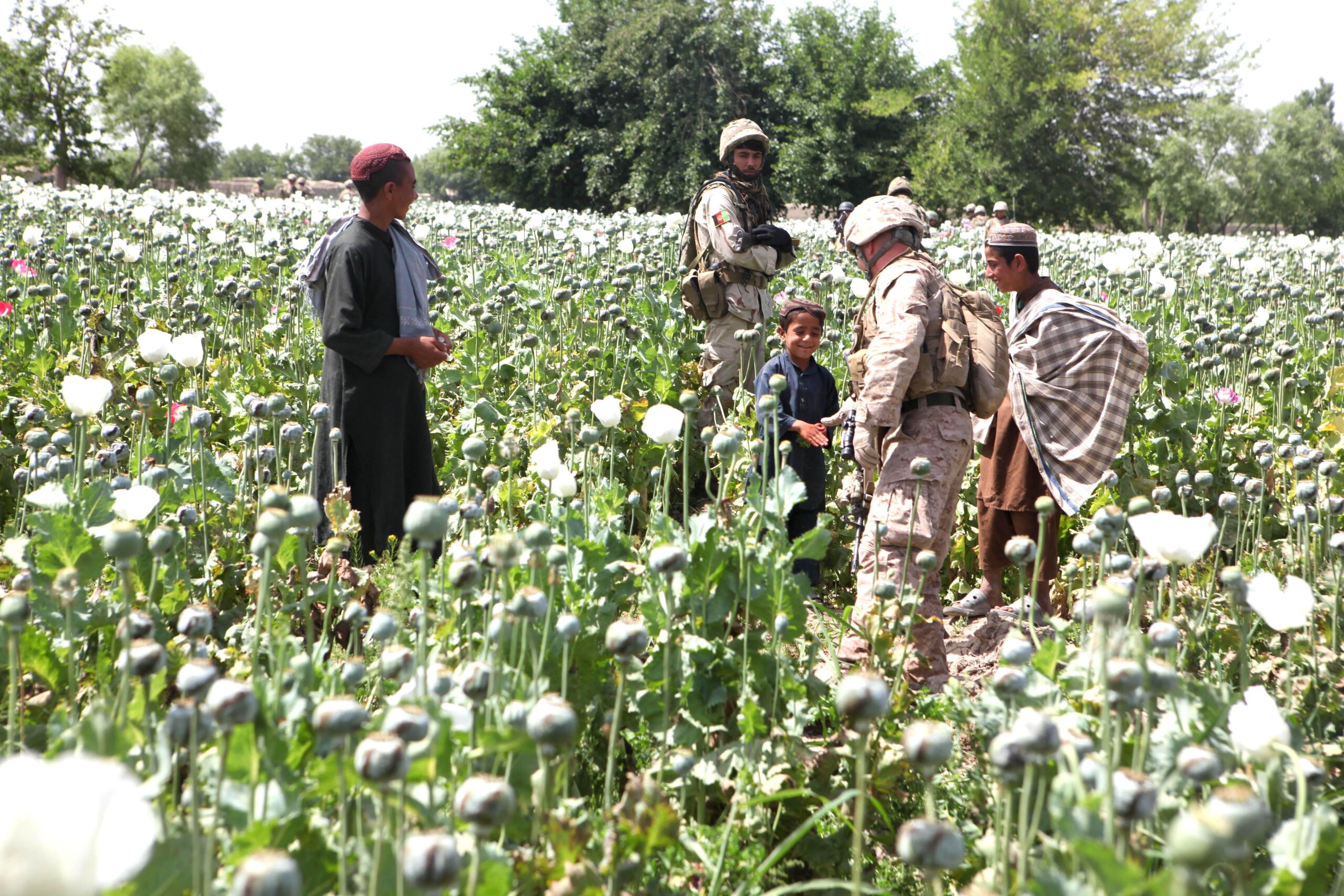
A U.S. Marine greeting local children working in an opium poppy field in Helmand Province, 2011. (ISAF / Wikimedia Commons / Public domain)
Chris Hedges: Well, Hamid Karzai, who was our puppet, and his brother controlled 90 percent of the heroin trade. And what Seth documents in his book is how Delta Force
and these other elite units came back, essentially, and started
dealing, they could ship the drugs over easily, started dealing drugs
all up and down the eastern seaboard.
Maureen Tkacik: And
he also documents this really systematic effort by the D.E.A. to
suppress the evidence that this is happening. So, they’re saying, hey,
look, we’ve tested the heroin and absolutely no heroin from Afghanistan
is coming into America. It’s all from Mexico or it’s all from here. And
those kinds of efforts that are made to conceal and distort what is
plainly happening that everybody knows is also really quite astonishing.
And
in the earlier days of the D.E.A., the agency had, I think, I’m not
sure, but it seems like the agency had a lot more folks working for it
who understood that their relationship with the C.I.A. was going to be
adversarial and that in order to like actually eradicate drugs, they
were gonna come up against some very powerful people within their own
government.
Like
that was sort of understood. I think by now the D.E.A. is just fully in
on it. But I felt a similar… When he’s been given a lot of interviews
describing how rigorously he fact-checked his thesis because the
propaganda was so… the certainty was among all of the chattering classes
that… it’s sort of like, “Maduro is a terrible, ruthless killer.” So
many people will tell you this with all the conviction you could muster,
but you don’t really ever know where it comes from.
And
in this case, it was the same. We accused the Taliban of being drug
traffickers. We were the drug traffickers. And as soon as the Taliban
takes charge, they get rid of the drug traffickers, and that’s why we
hate them. And that’s why they hate us.
Chris Hedges: Well,
we also occupied their country for 20 years. I want to talk about
Iran-Contra, which I did cover, because it was during the [Ronald]
Reagan administration, and Reagan was having trouble getting funds
approved. The Congress was more adversarial. Now it’s completely supine,
of course.
And so they set up this system of trafficking drugs to fund the Contras. Edén Pastora,
who was a renegade Contra leader operating out of Northern Costa Rica, I
knew him as well, was very involved in this, as was Félix Rodríguez,
who went by the pseudonym Max Gómez. But talk about that, because it’s
an important moment where you’re, in essence, really setting up this
infrastructure which continues.
Maureen Tkacik: Sure,
I would just like to say the infrastructure did predate Iran-Contra.
One of the reasons that these gentlemen have been so resilient in our
deep state is because they funded their own, they self-funded their
operations. So the Church Committee happens, the C.I.A. endures all of these scandals in the 1970s. You wanna do some covert ops, who are you gonna call?
This
was happening very early. Artime was getting in all of these scandals.
There was the woman whose husband had been murdered. There was also, he
had this wife who was maybe a bit of a prostitute. She’d been the
mistress of [Fulgencio] Batista and some other big dictators and she’d also posed for smut, lesbian smut.
And
so they send him off to Nicaragua and he sets up a base there. This is
sort of the start of this Black Ops regional dirty army that does a lot
of coke trafficking, but they also sort of form militias. And there’s
something called Operation Condor,
which actually turns out to be two things, but maybe they are the same.
And it supposedly started with Pinochet and the Argentinian…
Chris Hedges: It was three countries that united to fight communism, led perhaps by Argentina and Chile, right? Operation Condor?
Maureen Tkacik: Yes,
so that is the one that most people know and supposedly launched in
1975. But I was speaking to a scholar of this stuff who was saying,
really, it started with the murder of Che Guevara posing as a Bolivian
colonel. But Félix Rodríguez, this Bay of Pigs veteran and this sort of
long-time C.I.A. asset, and he also, he not only took Guevara’s Rolex,
but apparently he would brag that he had cut off his finger and sent it
to Fidel Castro.
C.I.A. agent Felix Rodriguez, left, with Che Guevara, center, before Guevara was executed in Bolivia, in 1967. (AP Photo / Courtesy of Felix Rodriguez / Wikimedia Commons / Public Domain)
So
I’ve been told that, this is in 1967, this is sort of the soft launch
of Operation Condor and the beginning of this kind of like cooperation
between all of these right-wing forces throughout Latin America.
There’s
another Operation Condor in Mexico that started in the early 70s that
was a crackdown. It was a specifically sort of D.E.A.-Mexican military
project that cracked down on marijuana farmers.
And
this was… I don’t know if they were the same thing but it had some of
the same effects. It was this real crackdown on left wing sort of
guerrilla movements, labor organizers. It was very easy for them to get
sort of rounded up in this blitz to eradicate marijuana throughout
Mexico.
So,
all together we see an enormous amount of cooperation. A lot of it is
orchestrated by the C.I.A. Pinochet at some point comes in and does some
things that the C.I.A. supposedly doesn’t know about.
I
read one interesting passage about how the C.I.A. wasn’t really on
board with Operation Condor. They weren’t entirely behind it and they
were very, very intent on making sure that it wasn’t headquartered in
Miami because that would have been the obvious place to headquarter such
a mission. But all of these guys funded their operations by trafficking
massive quantities of drugs.
And
this is something that like there is on the left, I think there’s this
sort of conventional wisdom. This public intellectual, Michael Massing, he’s got a Genius Grant, he’s written a few books on drug policy. And his line on Gary Webb was always like, it didn’t really matter that the C.I.A. was…
Chris Hedges: Let
me just interrupt for people that don’t know, Gary Webb was the
reporter who really broke the story, he did break the story of the
shipment of cocaine by Contras and C.I.A.-affiliated operatives into
American cities like Oakland. The press, the establishment press, worked
overtime, including, I was at the New York Times, to discredit him.
They
discredited him not by going down and checking on his reporting or
trying to re-report what he did, but by getting background briefings at
the C.I.A., and then he ultimately committed suicide.
Maureen Tkacik: Yes,
and with the benefit of hindsight, it is absolutely mind-blowing to
read any of the reports from Iran-Contra or a lot of the sources that I
used in this story just came from some of the collections of
declassified JFK files, right? Because these guys also were deeply
involved in that assassination and others. You can look up, anybody who
was a Cuban exile in Miami in the 60s, you can probably see if they’ve
had any prominence.
You
can probably find some information about them in these files. But
anyway, you look at the evidence that was just known by the end of the
80s about the C.I.A. involvement and the Contra involvement in drug
trafficking and this wasn’t new news. [Robert Parry, the founder of Consortium News, first broke the story for the Associated Press of Contra involvement in the drug trade.]
One
thing that Gary Webb really, a connection that he really nailed down
was the connection between the drug dealers that really first
popularized crack in the… I think Rick Ross was the name of one of them
in 1985, because when crack hit, I mean, it hit, it changed everything.
When I started writing for newspapers in the mid-late nineties, crack
was still people under the influence, it [was] the source of a lot of
violence in cities.
It
was a drug that really had just a devastating effect on already
devastated American cities. And he nailed down the connection between
this C.I.A., this just massive supply of cheap drugs and this
desperation to find new customers for this stuff. And to do that, they
had to go to people who had way less money than your average cocaine
consumer. And that’s what they did with it. This supply matters.
You
know, there’s this idea that the only way you can really fight drug
addiction and the scourge of illegal drugs is by working on the demand.
And there’s an element of truth to that. It makes a lot of sense. But
the fact is, our government’s run by drug traffickers, our institutions
of power. And that’s one of the reasons, look at what the Sacklers did. That was a supply side addiction epidemic.
And
we allow these things for whatever reason, but the evidence was
absolutely overwhelming that the C.I.A., that the highest levels of the
American intelligence apparatus were deeply involved. And even that,
there’s a documentary that came out recently that has a lot of quite a
few D.E.A. and other intelligence officers from the 1980s saying that
Félix Rodríguez himself, remember this character who assassinated Che
Guevara, Bay of Pigs veteran…
Chris Hedges: He didn’t actually assassinate Guevara. It was a Bolivian soldier shot, but he was there. Just as a small point, he was there.
Maureen Tkacik: He cut his finger off after he was dead.
Chris Hedges: Well,
no, he sent the… He is assassinated in the sense that they ordered,
they determined that there was no way Che was going to — he was captured
alive, of course — was going to live, but he didn’t actually pull the
trigger. They got some poor Bolivian soldier to do it. That’s just a
small footnote. You can read Jon Lee Anderson’sgreat book on Che.
Maureen Tkacik: Sorry.
But Félix Rodríguez is supposedly now, according to these folks, the
guy who actually ordered the murder, the torture and subsequent murder
of a D.E.A. agent who had sort of run afoul of it had become sort of a
whistleblower named Kiki Camarena.
Chris Hedges: This is Kiki Camarena.
Maureen Tkacik: Yeah,
and that is something that the cartels had long sort of been blamed
for. Now somebody tried to, I think, sue the Netflix documentarian for
defamation, but Félix Rodríguez, who’s still alive and still kicking,
indeed, recently hosted none other than Álvaro Uribe, former Colombian Prime Minister and good, good friend of Marco Rubio at a Bay of Pigs reunion event.
So
Félix Rodríguez is still a figure of some prominence in Miami. He’s got
a lot of blood on his hands, allegedly and not allegedly and by his own
testimony. But this is the type of guy who is sort of in the milieu of
this crew that ran this drug trafficking organization that Marco Rubio’s
brother-in-law had sort of ascended relatively to the number two spot
in essentially.
Another
thing that is interesting about Rubio’s own biography is that he has
said that his father trained at 18, I forget where, but he trained in
some training camp in Central America to — this would have been back in
the 40s — for a mission that never came off to overthrow and possibly
assassinate [Rafael] Trujillo,
the 30 year dictator of the Dominican Republic, who was sort of a
C.I.A. asset and then sort of a C.I.A. thorn in its side for many years.
So
I don’t know, that’s the only sign I’ve ever gotten that Rubio’s own
family was involved in any of this stuff. His family came to Miami
before the revolution, escaping Batista, and then subsequently would
move back and forth, trying to kind of scrape some money together
because I don’t think that anybody in his family was particularly
privileged.
Rubio
would change all that. And one thing that’s really also fascinating is
that the prosecutor that prosecuted his brother-in-law and the entire
drug trafficking organization, then the following year prosecuted Manuel Noriega
in a really fascinating trial that is another one of these unbelievable
windows into the C.I.A. involvement in drug trafficking.
Because
Noriega’s defense attorney, and a lot of evidence was suppressed in
this case, but his defense attorney was constantly cross-examining
various government witnesses saying like, okay, wasn’t the C.I.A. paying
Noriega this whole time as well? And Noriega claimed that he’d made $10
million cooperating with the C.I.A. over the years.
Panamanian military leader Manuel Noriega in a 1990 mugshot taken after his capture by U.S. forces. (U.S. Marshals Service / Wikimedia Commons / Public Domain)
They
never had any problem with him facilitating money laundering. And
that’s the other thing, so there’s a lot of rich history. That
prosecutor then, his wife, gives Rubio his first job literally like the
year after the indictment. I think that this might still be going on
during the trial or directly after the trial. The prosecutor’s wife, Ileana Ros[-Lehtinen], God, what is this last name? I can never… she’s a giant in the Congress in Miami, a good friend of Debbie Wasserman Schultz.
And her father was another Cuban exile deeply involved in Voice of America, I believe [he hosted shows for U.S.-funded Radio y Televisión Martí.]
But this congresswoman gave Marco Rubio an internship when he got out
of high school. They were very early on, it was decided that he was sort
of a preternatural political talent. His ties to drug traffickers never
stopped Marco Rubio, but he is very sensitive about the story, he
really went on a little jihad against Univision when they broke the story.
And
it’s just not really necessarily part of the conventional wisdom of who
he is. And I think it’s important not because I would accuse Marco
Rubio of being involved in drug trafficking himself, but understanding
the landscape of social capital, not to sound annoying, in Miami in the
1980s to understand how intertwined right-wing politics and drug
trafficking are in that community and how sort of this cognitive
dissonance is just something that everybody lives and breathes down
there.
Drug
crimes are only illegal when the wrong people are committing them and
that is something that is understood in, I think, throughout Latin
America that we don’t seem to comprehend.
Chris Hedges: Yeah, you succinctly write,
“Drug
traffickers who were allied with the C.I.A.’s ideological objectives
were protected, assisted and/or recruited as assets, while drug
traffickers who bribed or cooperated with leftists, crossed the Agency,
or outlived their usefulness were set up for prosecution or discarded.”
That’s
precisely correct. And I want to also mention, and you may have heard
this, but the common understanding is that Maduro, like [Claudia] Sheinbaum in Mexico, was fairly clean.
Maureen Tkacik: Oh
my god, yes. I have read the indictment against Maduro. There are
episodes, it’s a strange document. Nothing like the indictment of Juan
Orlando Hernández, which is very, it’s a classic indictment. The
evidence is there. You see it. I don’t know how the grand jury that… I
could see a Florida grand jury going for this, but it’s not very strong.
And
one of the things, one of the pieces of evidence, one of the passages
that was most bizarre to me was this, they have a section about toward
this 2013 drug bust, the biggest drug bust in the drug seizure in the
history of commercial air travel was 2013 Charles de Gaulle Airport,
probably one of the biggest, most busiest airports in the world — 1.3 tons of cocaine are found in 33 suitcases in this Air France flight from Caracas.
Immediately
Maduro, who is very new, Chavez has just died, he’s just taken over, he
has 25 airport security and sort of military officers who are involved
in the airport operation arrested. And then this strange British guy
gets arrested for having claimed on a wiretap that he was the actual
owner of the 1.3 tons of cocaine.
He’s
a very strange figure, supposedly a big crime boss in the U.K., but
he’s never really been written about before that except for some very
strange harassment charges, doesn’t seem particularly bright.
And
his lawyer claims, and then he later claims, no, he was just saying
that the coke was his on the wiretap to get them off his back. I don’t
understand. I’ve been meaning to kind of look into this a little bit
more closely, but it seems like it was some sort of setup, this whole
thing. It’s a very strange way to try and traffic cocaine, just putting
it into suitcases in a commercial airliner that is destined for the
busiest passenger airport in the world.
Something
about that is a little off to me. The whole thing is a little off. And
there was never any suggestion that Maduro had any involvement or
knowledge in that. And at the time, none of the investigations revealed
anything of the sort. But it’s used in this, it’s deployed in this
indictment as like this sign of what an unbelievably prodigious drug
trafficker Maduro is. So a lot of it is stuff like that.
There’s
something about Malaysian heating oil. The fact is that commerce itself
in Venezuela is mostly criminalized because of the severity of the
sanctions that we’ve imposed over the years on that country.
I
think that we almost feel like, as you see with the blowing up the oil
tankers, there’s this sense of entitlement that we have to sort of get
our way with Venezuela because we’ve literally criminalized most of the
economic activity that that country is involved in.
Another thing about Maduro is that he has two nephews who were
apparently arrested for narco trafficking a few years back and they sort
of claimed that they were framed.
President Nicolás Maduro of Venezuela, 2016. (Cancillería del Ecuador via Flickr)
They
don’t seem particularly intelligent. They were trying to do a drug deal
so that they could get some money to win, I think, the 2018 election.
But this massive quantity of cocaine apparently was found in their room
at La Romana, I think that’s what it’s called. It’s a resort in the Dominican Republic. It’s owned by the Fanjul family.
One
Bob Menendez in 2013 claimed that he was, that the Fanjul family was
trying to set him up by sending whores to his villa at La Romana. It
just triggered something in my mind, like, hmm, I wonder if there’s
something to that. I wonder if that cocaine they found really belonged
to the narco-nephews. What’s really going on there? I wanna delve a lot
more deeply into this, but the indictment against him, I don’t
understand how they think…
Now,
Miami, if they were trying him in Miami, he might be a dead man. But in
New York, are they going to get a conviction in New York? On this? It
seems absurd.
Chris Hedges: I
want to go back to Rubio. You’re right, when Marco Rubio maligns the
efficacy of interdiction and other traditional law enforcement
approaches to mitigating narco trafficking in favor of military
operations, as he did in a recent speech on Trump’s speedboat bombings,
he is contradicting every empirical evaluation of drug war efficacy that
exists, yes.
But
he is also pining for a kind of Cold War-era blanket license to commit
dirty war in the name of some bigger goal. I was telling you before we
went into the interview that I was in Argentina at the end of the dirty
war.
Of
course, Carter had imposed some sanctions, which Reagan lifted, a
full-throated support under the Reagan administration for this junta,
which disappeared 30,000 of its own citizens. But it was common
knowledge that in police stations there were large industrial-sized
freezers full of cocaine.
And
when we talk about that dirty war, that nexus, which I think you
capture in the story between drug trafficking and the desaparecidos, the
killing of labor union leaders, student leaders, they’re intimately
intertwined.
Maureen Tkacik: There’s a book called Powderburns,
I believe, by a former D.E.A. agent, recalling his odyssey of being rat
fucked by C.I.A. guys in his efforts to combat drug trafficking in
Latin America in the 80s and early 90s. And at one point he recalls a
few conversations where somebody’s like, well, the war on drugs is
important, but the war on communism is even more important.
And
he’s like, where are you from? Because I’m from, I forget, I’m from a
city that’s been devastated by deindustrialization and now is being
brought to its knees by addiction. I’m not a fan of communism, but I
don’t really think that it’s a threat to my society. He just describes
how he was not able to understand that rationalization. But now we’re
using the drug war as its own, as the same sort of blanket license.
And
what it really is, I guess, is the same as the Cold War, is this
country has decided to threaten… This is another thing, there’s so much
talk about the oil curse, and it is true. I grew up, a lot of my youth I
spent in China, my dad was in the State Department, and I always
wondered, gosh, the Taiwanese, they had a lobby just like the Miami
lobby, the Cuba lobby and the Zionist lobby, they have the China lobby.
And
they trafficked drugs and they were bad guys and they were right-wing.
But at some point, maybe they switched drugs for bicycles and then
semiconductors and they started to build factories in China even though
they were technically at war and those two places are very
interdependent right now.
There’s
a lot of parallels that we like to make, but why were they allowed? Why
was China allowed to build an industrial economy? And why did we allow
our agents in Taiwan to facilitate this? Would they have been even able
to do it if they hadn’t sort of all done it in Taiwan first and they had
the language, yada yada? It’s just such a different story.
And
it seems like part of the benefit that China had other than its 1
billion people was that they didn’t have any resources to exploit. It
had to be their human capital, as they like to say in the business. But,
we do not allow countries with resources to nationalize those resources
in hopes of trying to nationalize the surpluses that they might bring
and then diversify their economy into something more sustainable.
The
resource curse is something that countless nations, obviously Libya,
Iran, Venezuela, Russia have all tried to sort of reverse and figure out
how to deal with and whenever they do, they feel our wrath. And so it
really pisses me off when pundits talk about the resource curse as
though it’s not really the sort of gratuitous sanctions for having the
temerity to threaten hegemony curse.
Chris Hedges
Well, that’s how [Allende] was overthrown in ‘73. It was at the service of Anaconda Copper. It’s how [Jacobo] Árbenz was overthrown in ‘54 in Guatemala on behalf of United Fruit.
As soon as you go, and that’s what’s happening with Venezuela. Trump,
unlike previous presidents, was quite open about it. It’s about the oil,
the largest reserves of oil in the world.
And the article is smart and good and people should read it, “The Narco-Terrorist Elite.” It’s in TheAmerican Prospect,
where Moe works as the investigative editor. It’s really a fine piece
of journalism and important for understanding what’s driving this policy
and who Marco Rubio is. Thank you, Moe.
Maureen Tkacik: Thank you so much. It’s an honor.
Chris Hedges: And
thanks to Victor [Padilla], Diego [Ramos], Max [Jones], Sofia
[Menemenlis] and Thomas [Hedges], who produced the show. You can find me
at ChrisHedges.Substack.com.
Chris Hedges is a Pulitzer Prize–winning journalist who was a foreign correspondent for 15 years for The New York Times, where he served as the Middle East bureau chief and Balkan bureau chief for the paper. He previously worked overseas for The Dallas Morning News, The Christian Science Monitor and NPR. He is the host of show “The Chris Hedges Report.”